Learn to tell your science story in an interactive Science Communication Workshop
Let me tell you a story.
As a former microbiology researcher, I find it difficult to relate to how scientists present their experimental data. They see signals going up, colouring levels increase or protein bands becoming stronger. I, however, talk about bacteria swimming faster, producing colourful molecules or activating a killing machine.
What is the difference between these two viewpoints? One talks about static facts, the other tells a story.
A workshop on storytelling in science communication
Every scientist is a storyteller. And even though most know this to be true, they struggle with it.
They are brilliant at conducting research. Within their projects, experiments and data points, they see the connections. It is all logical to them since they are so deep into the topic. Yet they find it difficult to communicate their findings in a way that others can follow easily.
Explaining experimental results based on numbers and data is often the way scientists communicate their findings. However, what might be more relatable to an audience unfamiliar with the topic? From which will they learn more? Hearing about scientific data or a story?
Why storytelling in science communication
The human brain loves logic and tells itself stories about the surroundings to make sense of the world. Because of the underlying nature of stories, they have been around throughout humanity.
Stories were what our ancestors told each other around campfires. They are the first things young kids tell themselves to understand the world around them. Parents tell their children fairy tales to teach them about the world, history and morals. With stories, we comprehend bigger concepts by making logical sense of them.
Since the human brain prefers logic, we also understand facts and concepts better when they are presented as stories. So if we want someone not only to understand but also remember an important fact, it’s effective to pack it into a logical and comprehensive story.
Whether scientists share their experimental findings in a scientific journal, break them down in a social media post or introduce their research projects at a conference. Even when talking to neighbours, friends or family about their research, a logical and comprehensive story will help an audience connect with the science and get the big picture.
To create an engaging and logical story from a research project, we need four pillars: emotions, an interesting hero’s journey, active language and logical connections. Applying these will relate any science to an audience, make them care about it and help them remember and apply their new knowledge. And with this, scientific research will make a true impact.

In this interactive workshop on storytelling in science communication, participants will learn about the theoretical background of storytelling, craft their own stories and receive hands-on guidance and critical feedback to improve their stories for their target audience.
What a workshop on storytelling in science communication with me will look like:
Hi, I am Sarah, a microbiologist-turned science writer and communicator. Based on our successful guide on using storytelling in science communication, I created an interactive workshop and a self-learning video course to share and apply the storytelling model.
Read my publication “Transforming science into engaging stories” about my experience delivering the storytelling workshop at scientific conferences.
During this workshop, scientists will gain the following science communication skills:
- Understanding the importance of storytelling in science communication
- Breaking down complex scientific concepts into accessible story components
- Creating engaging and logical narratives from scientific topics
- Engaging an audience using emotions and relatable language
One workshop session is optimised for up to 30 participants. The session lasts 2 hours and consists of:
- 60 minutes: Theoretical background on storytelling in science communication
- 4 x 10 minutes: Participants working by themselves to apply the theory and create a story about one of their research projects
- 20 minutes: Asking questions and participants sharing their stories, open discussion and feedback
Thank you so much for all the practical tips on science writing. I learned so much in the workshop!
Participant at the FEMS Micro 2025 in Milano
As researchers, we should know how to write good stories about our projects. So it is great that finally someone tells us indeed how to do it.
Participant at the IPNC 2025 in Porto
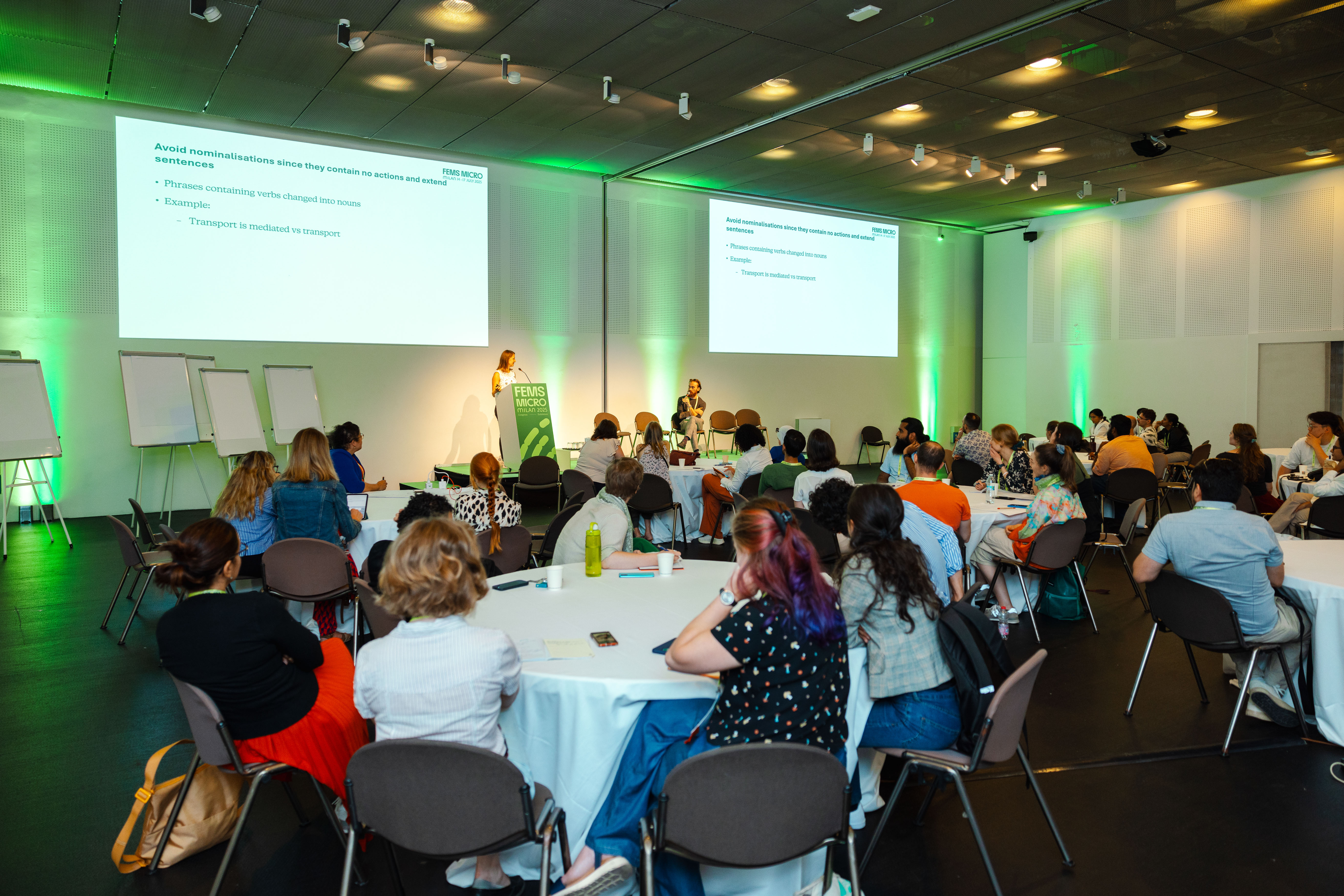
Throughout the entire session, I will be supporting the participants to develop their stories by helping them identify the essential storytelling components, creating engaging narratives and triggering the right emotions in an audience.
At the end of the workshop, they will have a story to publish immediately or to flesh out for bigger outreach projects. Every participant will also receive a certificate to add to their CV and social media profiles.
Ready to tell a story about science?
The goal of this workshop is for everyone to leave with an engaging and logical science story. They can share these during talks at conferences, on social media or as an elevator pitch. Or they can elaborate them into more comprehensive narratives for grant applications, research publications or job interviews.
Contact me now and tell me whom you want this workshop for, how many participants and when and where (in-person or online) you want it to take place. I am looking forward to hearing from you.
This workshop is part of the SciComm Society Storytelling System
The SciComm Society Storytelling System helps scientists turn complex research into clear, engaging stories their audience can follow. It brings together five pillars — target audience, emotions, hero’s journey, active language and logical connections — so your science feels relevant, human and easy to understand.
Built around practical tools, the system helps you shape stories from your research that people can understand, follow and remember. This workshop is the live, interactive version of the system, helping scientists apply the pillars directly to their own research and strengthen their stories through practice and feedback.