Prepare your science talk efficiently without reading from a script
Make your science easier to follow before you step on stage.
You don’t need to be a naturally confident speaker or have a perfect presentation voice to give a good talk. You need a clear message, useful preparation habits and opportunities to practise.
This free email course will help you build those habits, one practical step at a time.
Public speaking is a skill. It is the ability to communicate ideas clearly, coherently and memorably so that an audience pays attention, understands your science, remembers it and can apply what they learn. And like your scientific skills, it is a skill you can improve with practice.
A practical routine for your next scientific talk
Preparing a presentation can feel like a lot to manage: deciding what to say, writing notes, practising, keeping to time and figuring out how to deliver your science in a way people can follow. It can be tempting to write out every sentence and rely on a script. But you want to talk to your audience, not read to them.
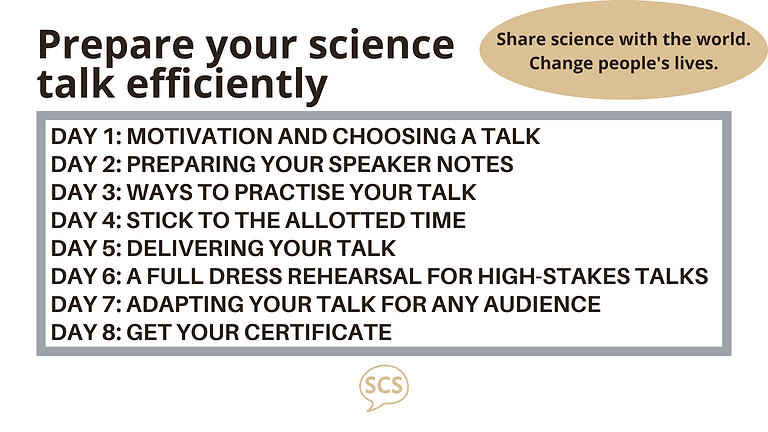
Over seven days, you’ll work on one talk—or one section of a talk—and develop a preparation routine you can return to whenever you need it. Each email focuses on a practical aspect of preparing and delivering a presentation, with an exercise to put the lesson into practice.
By the end of the course, you’ll have spent focused time working on your talk, practised explaining your science out loud and started building a personal preparation routine for future presentations.
What you’ll work on in the prepare your science talk efficiently email course
- Prepare speaker notes for speaking, not reading. Create a loose, logical framework of keywords and short phrases to guide you through your slides, help you remember your main points and make transitions between ideas.
- Practise by actually saying the words out loud. Find a way to practise that works for you, notice where explanations or transitions feel unclear and revise those parts until they flow more naturally.
- Make your talk fit the time you have. Time yourself at a natural pace and adjust your content. If the talk runs long, remove details that don’t support your main message rather than rushing through your slides.
- Use your voice to help people understand your science. Experiment with pace, tone and pauses to highlight important ideas. Speak naturally and authentically; you don’t need to put on a presentation voice.
- Rehearse as you’ll present. For an important talk, practise in conditions that resemble the real setting, deliver the presentation without stopping and use feedback to identify what to improve.
- Build a preparation routine you can reuse. Notice which approaches feel useful and natural to you, and record them as you go.
Who is this course for?
This course is for scientists who want to communicate their research more clearly and feel better prepared when speaking in front of others. You might be preparing for a conference talk, an institutional seminar, a journal club, a job talk, a teaching demonstration or another presentation.
You don’t have to think of yourself as a public speaker already. The point is not to become someone else or eliminate every “um” and “ah”. It is to practise communicating your ideas in a way that is clear, engaging and true to your own speaking style.
The course is especially useful if you have a talk coming up and know its intended audience and key message, with at least some of your slides ready.
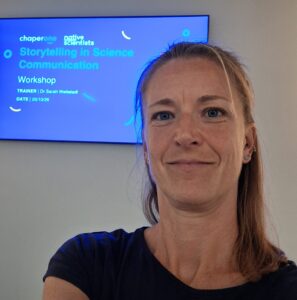
Hi, I’m Sarah
Hi, I’m Sarah, a science communicator and coach. Previously, I worked as a microbiology researcher. I’ve been there: I’ve given conference talks and seminars and sat through plenty of journal clubs. Now, I coach scientists to communicate their science more clearly through workshops, online webinars and other learning activities.
I created this free email course to share what I’ve learned about preparing and delivering talks that leave audiences with a clear understanding of the key message. I believe that with a logical structure, thoughtful preparation and a practice routine that works for you, you can communicate your science in a way that feels natural and helps your audience understand your research.
How it works
You’ll receive one email per day for a week, each with a short lesson and an exercise. Set aside around 10–20 minutes a day to read the email and work through the activity. Some lessons may take longer, and you can adapt the pace to fit your schedule.
Choose a talk or section you want to improve, then use the daily exercises to work on it. Start your own “talk preparation routine” note and add the steps that work best for you. By the end of the week, you’ll have the beginnings of a routine you can rely on for future talks.
Start with the talk you’re preparing now
You don’t have to wait until you feel confident to start practising. Confidence often grows as you do the thing you were nervous about—and each focused practice session gives you a chance to make your talk clearer.
Choose a presentation, make a little time each day and work through it step by step.