As a microbiologist-turned science communicator, I want to shift the focus of this blog towards the microbial world. To me, educating the younger generation on the fascinating microbial world is vitally important.
Since microbes are inaccessible to the naked eye, it is tricky to get young ones interested in them. That’s why as a science writer and communicator, I am constantly on the lookout for engaging ways to inspire curiosity, wonder and learning in children.
One way to spark interest in them is using creative media like colouring books. These bridge the gap between education and entertainment, making the learning process fun, accessible and enjoyable.
Throughout the past years, we’ve been creating blog posts featuring engaging stories on bacteria and their impact on our daily lives. All illustrations on BacterialWorld are hand-crafted by the artistic wizard Noémie Matthey. So, it was only logical to create a colouring book as educational material based on a similar concept: strong and captivating visuals that illustrate scientific concepts together with engaging text-based explanations.
Introducing the colourful bacterial world
A while ago, we developed the idea to create a colouring book not only for kids but also for adults. We wanted to introduce our readers to the multifaceted world of bacteria. We decided on a colouring book presenting 26 bacteria, one for each letter, and named it “Coloured bacteria from A to Z“.
In the book, each of the 26 bacteria is presented on four pages: two illustrations and two explanatory paragraphs. On the first double page, the illustration and paragraph introduce a general and simple concept of the bacterium. The illustration has large areas to colour and contains the name of the bacterium and is thus aimed at younger kids.
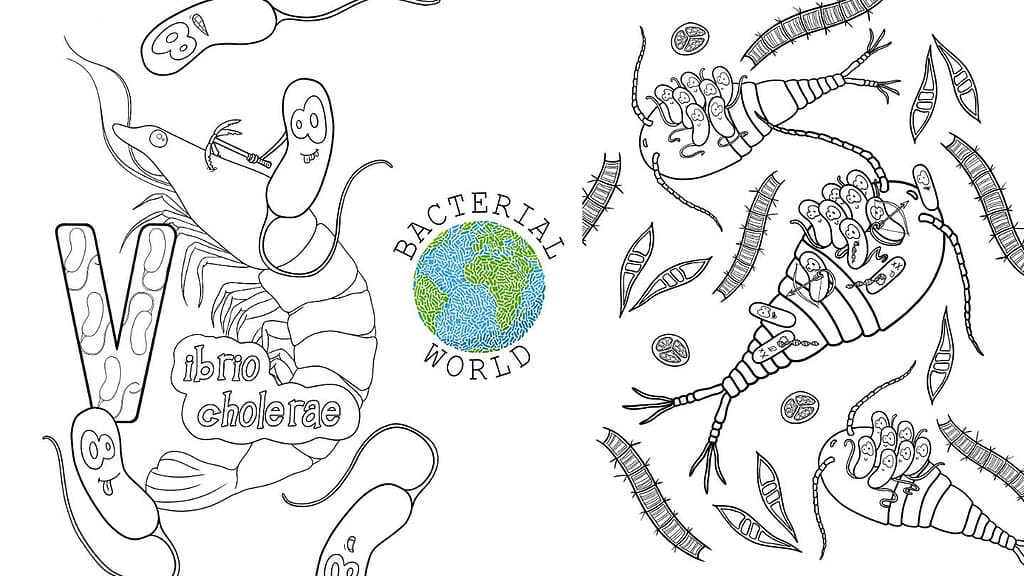
The second double page explains the bacterium in more depth. The illustration contains more details and smaller areas to colour, while the text uses longer and more advanced words. The idea is that both younger and older kids or even adults can enjoy the book together and learn about the bacterial world.
Going on a colourful journey into the world of bacteria
In the colouring book, we describe general microbiological topics such as the shapes, sizes, colours and composition of bacterial cells, their reproduction strategies and cell division. The book explains several unique and specific metabolic abilities of bacteria, the so-called bacterial superpowers.
Since many people have an apprehension or even fear of bacteria, the book focuses on their beneficial impacts. We delve into microbial fermentation and its impact on food production, as for Lactobacillus bulgaricus involved in the yoghurt-making process. We also talk about plastic degradation by Ideonella sakaiensis and the role of the gut microbiota in food digestion and human health, introducing Ruminococcus gnavus and Faecalibacterium prausnitzii.
To show the significance of bacteria in the environment, we introduce Pseudomonas putida and Wolbachia pipientis. These two interact and support the health of plants and animals respectively.
In an attempt to stun the reader, we talk about colourful bacteria such as Gemmatimonas aurantiaca and Janthinobacterium lividum. We describe the origins of their vivid and strong colours and explain how these colourful pigments help the bacteria survive in the environment.
To further counteract the fear of bacteria, we also humanised bacteria. We gave them relatable character traits and talk about what bacteria eat, how they move and where they feel comfortable. All of this has the goal for people to relate with bacteria and see them rather as friends than as foes.
Yet, bacteria do have challenging impacts on our lives and we needed to speak about these as well. We wanted to raise awareness on important bacteria-related topics such as food safety and transmissible diseases.
For example, we introduce the two nasty pathogens Vibrio cholerae and Yersinia pestis and explain their impacts on human health. We also explain the virulence strategies of Neisseria gonorrhoeae and Helicobacter pylori, discussing how they use these mechanisms to survive rather than to make us sick on purpose.
The magic of handcrafted illustrations
In the colouring book, the art is a central part of the learning experience. The book features beautiful, witty and handcrafted illustrations that appeal not only to children but also to adults. Bacteria are pictured in their natural environment with their different shapes and cellular extensions, all meticulously detailed.
The illustrations aim to demystify the concept of bacteria. Often, bacteria are seen as abstract, even a little scary, especially to young children, since they are invisible to the naked eye. Yet the illustrations in the colouring book introduce bacteria in a fun and intriguing light.
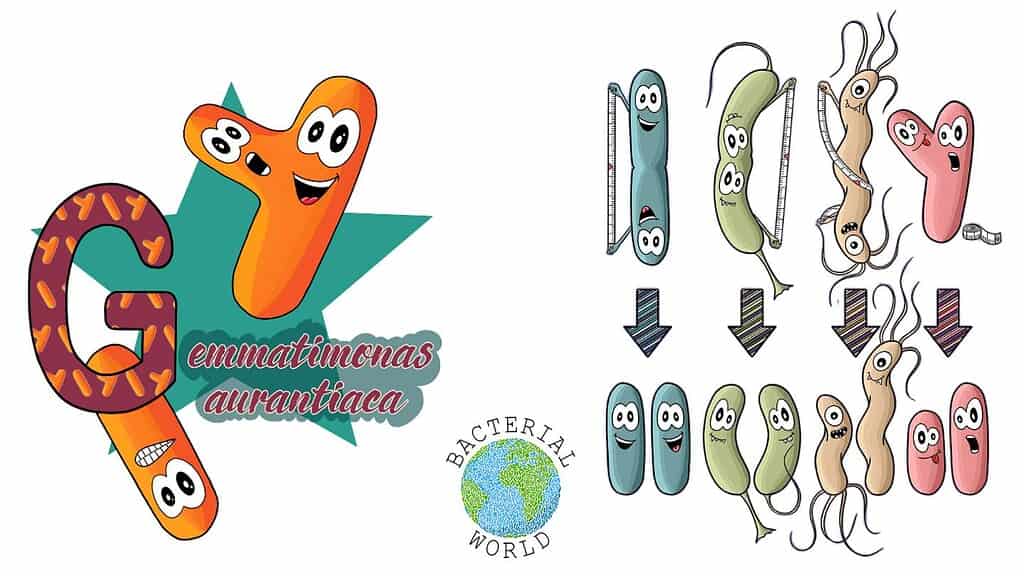
To translate scientific concepts in simple and visual manners, we use inspirations from daily life. For example, we introduce bacterial cell division during which bacteria extend their cell bodies. We represent the process of measuring the cell length with measuring tapes. Based on the middle of the cell, bacteria use that checkpoint to divide and create two identical daughter cells.
We then introduce Gemmatimonas aurantiaca because of its unique way of producing daughter cells. Instead of dividing in the middle, Gemmatimonas aurantiaca grows a daughter cell as a budding body from its cell. We show this fascinating phenomenon as bacteria with surprised faces.
By adding these fun and illustrative concepts, it is easier for children to understand how bacterial cell division may lead to daughter cells that are not identical in length. Eventually, children can better understand and relate to microorganisms since they are visually introduced to the world of bacteria.
Encouraging active learning about bacteria
On top of illustrations and text-based explanations on the different bacteria and their superpowers, we added quizzes as interactive elements to engage children. The idea was to invite children to dive in, interact with the content and engage with what they have read.
The book’s hands-on approach is designed to make learning both effective and enjoyable. In contrast to traditional reading, we wanted to create a medium which children not just consume to gain knowledge but in which they actively participate in their own learning journey.
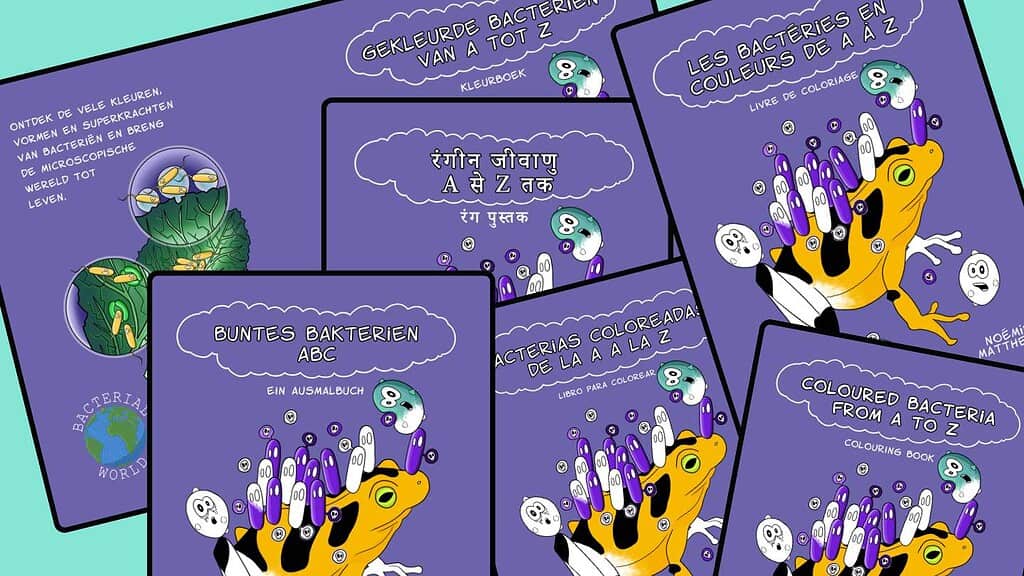
Another important aspect for us was to reach a global audience. That’s why we translated the colouring book into several different languages. We, as the creators of the book, use English as our working language but also translated it ourselves into both our mother tongues, French and German.
Several microbiology researchers from various countries then offered to translate the book into their native languages. So by now we have additionally published the book in Spanish, Italian, Portuguese, Dutch, Yoruba and Hindi.
A microbiology resource for teachers and parents
Another one of our aims was to create an educational resource for teachers and parents. For educators, it serves as a valuable tool in the classroom as they can print the PDF sheets as many times as they need.
On the other hand, the book is an entertaining tool for the whole family. We see the younger ones colouring while the parent or older sibling is explaining or comprehending what they just read. Hopefully, these shared learning experiences spark children’s interest and curiosity in science while creating cherished memories.
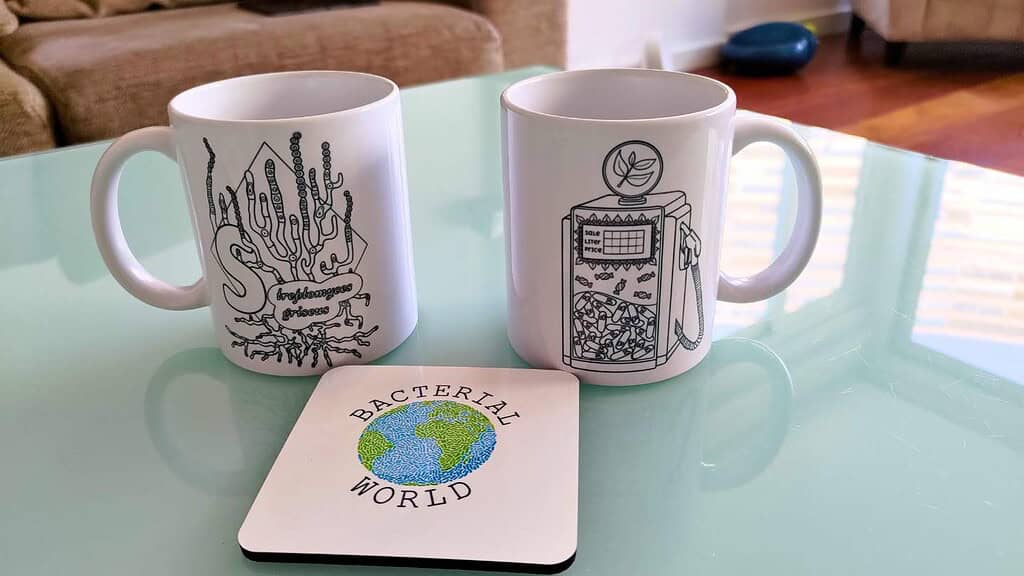
Lastly, we went one step further and brought the colourful bacterial world closer to home. We designed cups, magnets, stickers, bags and shirts with illustrations from the book so that everyone can have a set of personalised items. While some choose cups or stickers that show their favourite bacteria, others may prefer items containing illustrations with the same letter as their own name.
Again, the idea is for people to feel more comfortable having “bacteria in their homes” and being less scared of them. These items can be purchased on Redbubble, while we are always open for new ideas and suggestions for bacterial items.
Embracing the bacterial world with creative mediums
As such, our colouring book is a treat for both the family and teachers. Our goal was to create an engaging and fun educational resource for young and old, sharing our love and fascination for the bacterial world.
When we say fun, we do not only mean the fun that children are supposedly having when colouring the illustrations. It has also been a lot of fun for us to come up with engaging illustrations and explanations describing complex scientific concepts.
Lastly, as a science communicator, my goal is to help everyone learn about scientific topics. This includes both us when researching the content for the book, our amazing editors who translated the book and obviously the readers colouring the illustrations.
By making learning enjoyable and engaging, we hope for everyone to get a better idea of bacteria and become more interested in the microscopic world. So, let’s keep sharing how vivid and colourful they are with engaging science communication projects!