Every scientist is a communicator. And every scientist is a writer, as we often share our research using the written word.
This makes every scientist also an editor, since after writing an article, we need to check whether it truly speaks to the intended audience.
Why editing a science article matters
Writing about science is one of the most effective ways to share scientific knowledge. You directly connect with your audience, helping them learn and care about a topic that you deeply care about.
That’s why many scientists start writing a science article by just pouring out all their knowledge. They add as many details, as much information and as many technicalities as possible.
Well, this may make sense in that moment. But unfortunately, this approach leaves us in the position of the expert—and the first draft reflects exactly that.
But our audience sits in the position of the non-expert. That’s why we need to adapt our article to our target audience. Only then will they learn from the article and adapt their new knowledge to their own lives.
In this blog post, we’ll explore the scientific editing process; we’ll look at how to improve content flow, close knowledge gaps and refine language to ensure consistency. Whether you’re writing for a scientific journal, a blog, a newsletter or a popular science magazine, these editing strategies will help you create articles that share science and engage your audience.
How to edit science articles
Let me tell you that right after writing the article, your brain is still too deep in the topic. That’s why it’s crucial to give yourself time before editing your draft.
I recommend waiting at least one day to clear your head and gain fresh perspective. Then, approach the editing process with an open mind. Put yourself in your audience’s position and shift from writing mode into editing mode.
For efficient editing, read the text at least three times. The first time, focus on structure, story and content flow. The second time, focus on language, clarity and voice. The last time, focus on grammar, spelling and consistency.
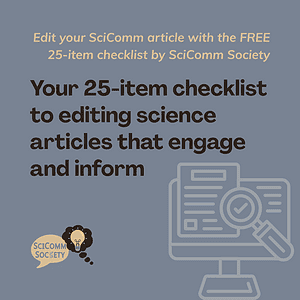
Want a step-by-step guide to improving your science article? Download SciComm Society’s FREE Editing Checklist to ensure you don’t miss any crucial steps. It covers 25 items—from structural improvements to final grammar checks.
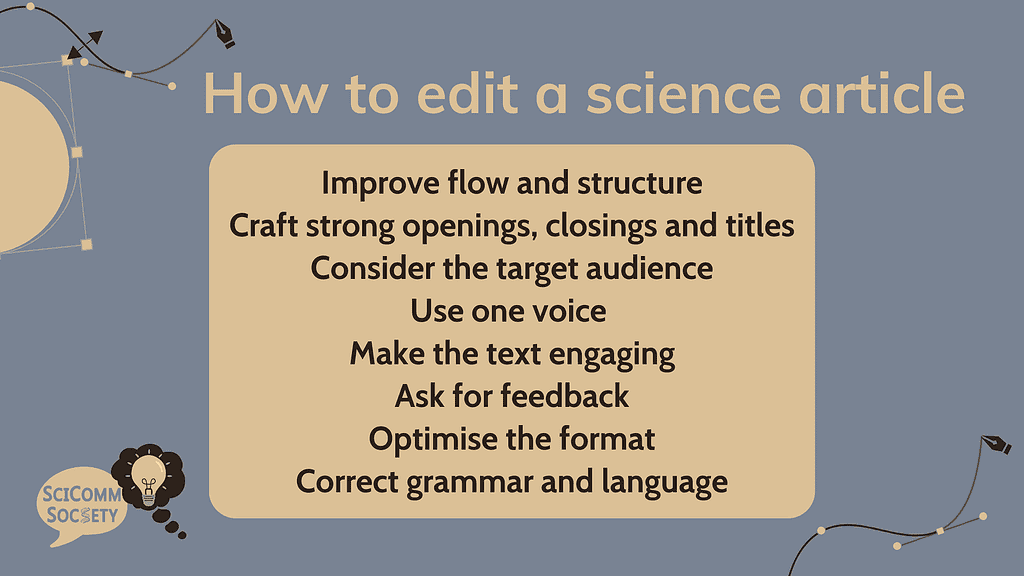
Improve flow and close knowledge gaps
The first thing to focus on during the editing process is whether the story and content flow and make sense to your reader. For an expert scientific audience, it may be advisable to describe the series of experiments that you did to get to the conclusion of the article.
However, for a non-scientific audience, this is not the case. They barely understand the scientific concept, let alone the molecular background of your experiments. To help them get your science, you need to create an engaging story from your data.
In either case, it is crucial to structure the content logically so your audience can follow the story. And whilst re-organising the article, make sure knowledge gaps are closed. Lead your reader through the story from one idea to the next.
This also includes linking sentences and paragraphs effectively to each other. This ensures information flows smoothly, helping the reader follow each one of your ideas and grasp the scientific concept.
Craft strong openings, closings and headers
Once you’ve created a strong, logical structure for your article, ensure the opening—or hook—engages your reader. Does the introduction clearly state what your reader will learn?
Similarly, the conclusion should summarise the article and provide actionable takeaways. What key message do you want your reader to remember?
Throughout the article, use engaging and descriptive headers. Do the titles and subtitles summarise each section and guide readers through the story?
Make sure these signposts are clear, linked to your key message and help your reader follow the story smoothly.
Stuck with the writing process? The Advanced Science Writing Guide covers everything from outlining to formatting your online science article. It walks you through structuring content, crafting coherent stories and designing visuals that help your audience understand your science.
Consider your target audience
When you start writing, you likely know who will read your article. Yet while writing, we often lose sight of the target audience and slip back into knowledge-dumping mode.
So, when editing your article, think about what kind of background knowledge and understanding of the scientific concepts your audience has. Explain scientific terms, jargon and technical phrases that may not be well-known to them, weaving descriptions directly into the story.
Make concepts relatable and accessible and tell your audience where they may encounter them in their daily lives. This will ensure the text resonates with the reader’s background knowledge and level of understanding.
Use one voice throughout the article
Sometimes, and especially when writing for scientific journals, you may write an article with several authors. The final draft likely contains a mixture of writing styles and definitions and inconsistent use of phrases, descriptions, abbreviations and statements.
In this case, it is of utmost importance to choose one final editor from the team or hire an expert scientific editor to smooth out inconsistencies in language and writing style. This person also ensures that terms, abbreviations and scientific phrases are used consistently to avoid confusing the reader.
Make the text engaging and accessible
One myth that seems to hold in the academic field is that scientific writing is dry and boring. However, I think a scientific article should convey the same passion and sense of awe that you have for your research topic.
And this passion is represented in the language and voice that you use throughout. One practical tip is to read the article out loud. This catches awkward phrases and repetitions.
Focus on sentence length and structure: Break down any sentence with more than 30 words into two or three. If you must leave a sentence with more than 20 words, make sure it is followed by a short one. This will enhance the readability and accessibility of your text and engage your reader.
Also, ensure your language is active and uses powerful words to showcase the transformative nature of your story and your research. Cut redundant and unnecessary words and try to be as brief as possible.
Need more inspiration on how to make your science article more engaging and relatable to your audience? Find 10 short and practical free tips on how to improve the language of your science writing article.
Ask for feedback on the article
Even after going through all the above points, it may help you to ask for feedback on your article. You could ask friends and family or someone related to your target audience.
Ask them to point out areas they did not fully understand or where they were unable to follow the story. Make sure not to take that feedback personally! The goal is to improve the article and not judge your writing skills.
Listen to the feedback, even though you disagree, and learn from it—both on how to make your key message clearer and how to write better. See it as getting one step closer to making this article great!
Optimise the format
Depending on where you want to publish your article, the platform may have formatting or writing guidelines. Make sure to check these and format your article accordingly.
These could contain guidelines on paragraph or section length, word limit or spelling. To make a professional impression with the editor and increase the chances for acceptance, it is good practice to comply with their guidelines.
Correct grammar and language
As we know, most scientific literature is written in English. And the English language can be tricky to handle when it comes to grammar and spelling. Since only a few scientists have English as their native language, this can be a huge obstacle.
Hence, add one final round of scientific editing during which you solely focus on grammar, punctuation and spelling. Be sure to stay consistent with using British or American English and adding or omitting the Oxford comma.
Technical terms, as well as formatting numbers, dates and units, also warrant special focus on consistency. This will ensure your text sounds professional, increasing credibility and understanding.
Should you use AI to edit scientific articles?
Now that we’ve seen how scientific editing improves your article, you may ask whether to use AI for the editing process. Whilst this topic warrants an entire article, I want to comment on it briefly here.
I and others have seen that AI software is not reliable when it comes to writing scientific texts. Its algorithms lack data to write comprehensive and logical stories on scientific topics, so they end up creating false data and citations.
And obviously, this cannot be accepted for writing scientific or popular science articles!
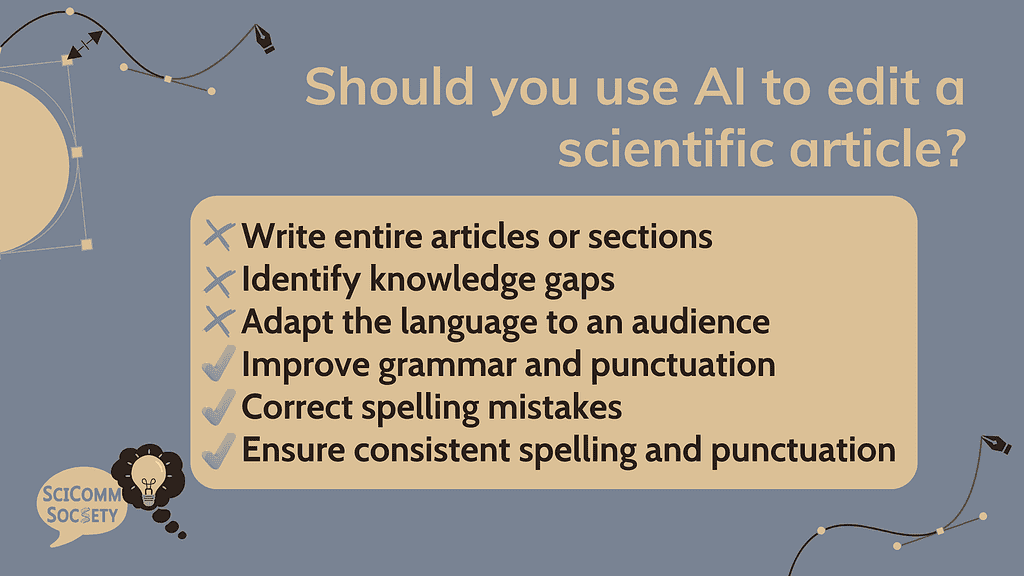
However, AI tools can help edit your scientific article. Free online grammar and spell checkers catch basic errors, improving grammar, punctuation and spelling consistency. To some extent, they can also suggest improvements to sentence structure and overall readability.
Yet, they fail to see the big picture and the overall content flow. They do not identify knowledge gaps or adapt the language, jargon or scientific descriptions to a particular audience.
So, yes, these tools can help you with the basic editing process. Yet, I suggest you as the writer or an expert science editor go through the article to make sure the content flows, is coherent and speaks to your audience.
Ready to polish your science article?
As with many communication skills, editing gets better with practice. You can start by implementing these strategies in your next article to improve your writing skills and the message of your article. Thoughtful editing of your written text ensures your audience connects to it and understands your science. There is almost no easier way to help them learn from your science!
To make the process easier, download SciComm Society’s Editing Checklist – a comprehensive guide that walks you through 25 editing steps, from improving flow to perfecting grammar. Start editing your article now and make an impact with your research!