Recently, I had a bit of a shock moment about science communication, AI and my career.
After completing a huge life task, I now have a lot more time on my hands and obviously want to use it to focus on my work. So, I took to LinkedIn to look for new projects, writing gigs and opportunities. Apparently, this is what LinkedIn is good for.
I barely came across any real writing jobs. Instead, organisations are looking for AI prompt writers or editors of AI responses. Basically, the hired person would teach AI tools how to write content better.
The idea behind this is that articles will be solely written by AI. This means that science writing will be done by AI and real writers like myself will become obsolete.
That’s not a very optimistic outlook to me.
It also reminded me of the conversations I had with my SEO writing expert friend. He uses AI tools to create huge amounts of visuals and articles weekly to be seen on the internet and sell other AI-generated products like colouring books.
I published one colouring book so far in collaboration with my science artist friend Noémie Matthey, and it took us two years to create and publish it. Yet I am super proud of our work and consider the book high-quality educative material.
The issue with using AI to create online (SciComm) content
Obviously, I have no issue with using AI to create online content, but I urge people to be smart about it. If we keep churning out AI-generated content on the internet, either written or graphical, quality drops massively.
Everything already looks and reads the same while misinformation and inaccuracy increase since AI values all input data the same. With low-quality science articles online, people will trust science even less.
And this is exactly what I, as a science communicator, want to avoid.
I want people to trust science, its experimental results, findings and conclusions. I want people to learn from science, make better decisions based on science and improve their lives, protect the environment. The idea is to create a better future with science.
It’s tempting to use AI to write science articles. It saves time, money and energy. That’s why entire companies are already writing most of their blog articles and newsletters with AI tools – incredibly frustrating for freelance writers like me.
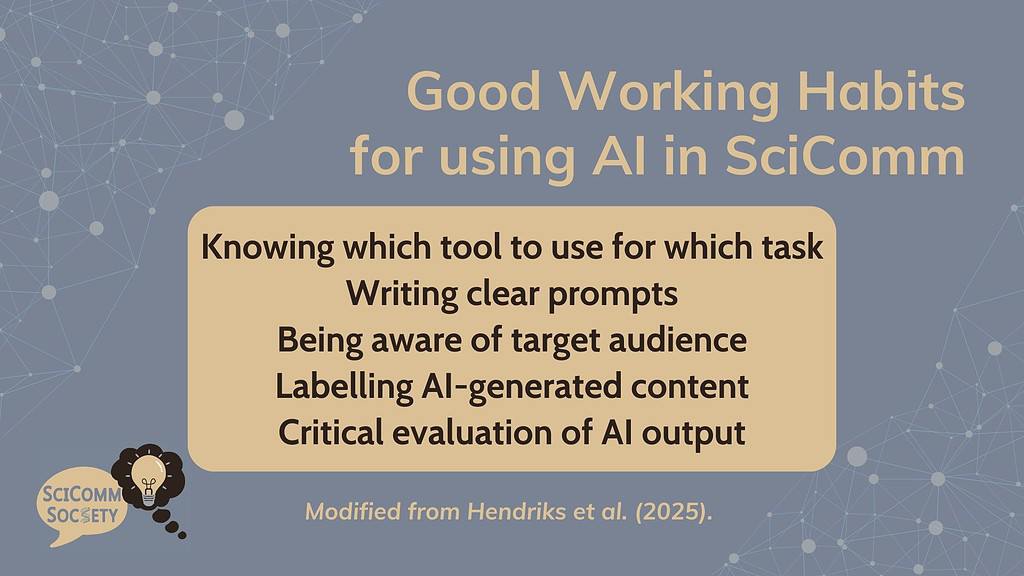
So, I want to call on science communicators and writers to think twice about how to use AI for their projects. Here, I will discuss some areas where we can use AI and give practical tips on how to include AI efficiently and ethically and where things get borderline. A recent study that I also just came across called it “Good Working Habits”.
Before starting, let me enclose that I obviously use AI in my daily work. I mainly rely on the integrated AI agent in my favourite management software Notion (affiliate). While it supports me in my writing tasks – as discussed below – I still mainly use it for project management purposes.
What AI is good for in science communication
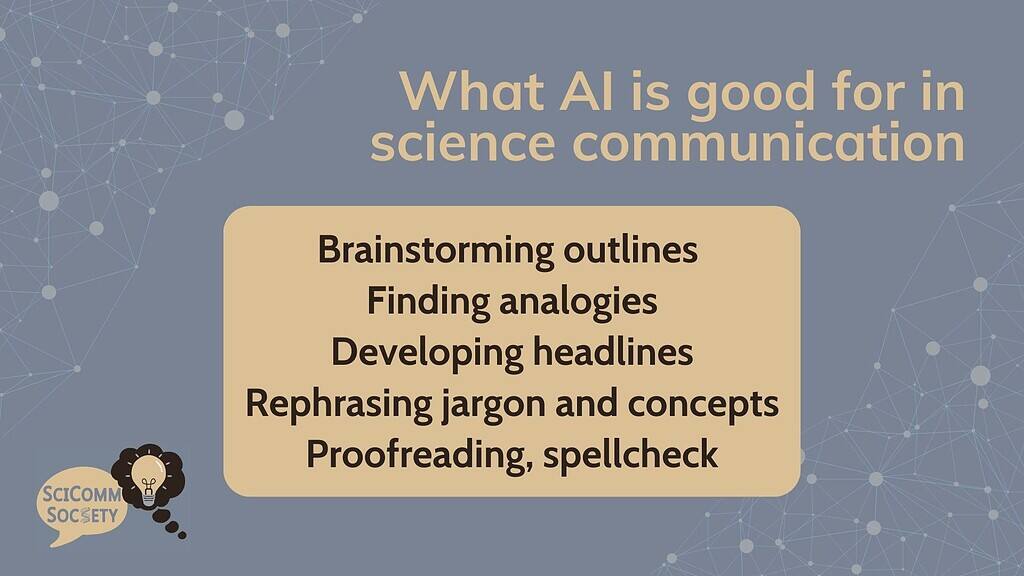
The two basic features I use Notion AI for in my writing are brainstorming and proofreading. I basically never let the tool create content for me. Since I do not fully know what training data the AI uses to create its content, I cannot rely on it as a basis for correct scientific information.
Plus, to write an article, I want to research the topic myself. This allows me to learn about it (one of the reasons why I became a science communicator!). I create my notes, filled with links, thoughts and comments. Once I feel I understand the topic and I see a story develop, I create an outline based on my notes.
Here, I often ask Notion AI whether the outline makes logical sense and whether I covered everything from my notes. It may tell me where to add explanations, cover different topics or go deeper. Here we usually go back and forth.
It’s like discussing your thesis or paper outline with a mentor or colleague. You know the stuff so well and the outline might make complete sense to you. But they will see it from a different angle and with a broader vision. Implementing their ideas will only improve the entire paper.
Where to use AI for science writing
From here, I start the writing process by myself. I may however ask AI to help me develop appropriate phrases, analogies or headings.
When stuck, I may ask it to explain a scientific term or concept and provide me with a reference to it. Yet I generally try to rely on my notes and scientific publications to understand the gaps in my knowledge.
With a first draft at hand, I double-check with my AI agent whether I included all relevant information or whether there are any logical gaps. The tool will point out jargon as well as tricky sections and phrases that may need improvement. Depending on the audience I intend to reach and the field I write about, I will adapt the article.
Again, I see it as feedback from someone else reading my draft. It is still my decision whether I take over the suggestions or not and how to improve the text.
After at least two comprehensive editing rounds, I obviously ask the tool to proofread, checking for grammar, consistent spelling and punctuation. Gladly, Notion AI shows me each suggestion before implementing them, so it’s still up to me to take over what I deem correct.
A recent study also showed that scientific publications improved with the help of an AI tool were of higher educational quality than those which received no such feedback. To me that is proof that texts improved with AI only get better and more engaging.
What’s the end product?
I would say it’s still 100% human content that I produce. Yes, I ask AI for ideas, tips or explanations, but I still write, edit and adapt its suggestions according to what makes sense to me.
Am I saving time and effort with AI? Surely. The proofreading process became so much easier than reading a text three times and still having one little spelling mistake hidden somewhere.
Am I being less creative thanks to AI? I feel my creativity even gets a boost. Instead of being unsure about an analogy or explanation and eventually scrapping it due to a lack of confidence, AI would help me improve it, leading to a pretty decent result. Again, it’s like having a personal sounding board at your fingertips.
Plus, I think the end product is better than if I had written the article all by myself. Mainly because I add ideas and suggestions from AI that I would probably not have come up with on my own, the explanations and storyline only get better. This makes the entire article better, helping both me and others learn more. And this is exactly what I’m aiming for.
In all, as I said in the beginning, I’m not at all against using AI in science communication. But we should be smart about it, follow SciComm “Good Working Habits” and evaluate its output critically. If someone decides to create content with an AI tool, it should be clearly labelled as such.
The goal is still to create transparent, high-quality content that explains science in an engaging and relevant way. And yes, I think AI makes this possible!