As a science communicator, you are probably driven by several goals. Maybe you decided to stimulate interest in science, educate or improve scientific literacy, or shape the next generation of scientists. You spend hours and energy on your project, sharing and translating scientific knowledge in the hope that someone listens and applies what they learn from you.
But when do you know whether you reached your goal? Do you ever take a step back and check whether your project achieved what you designed it to set out?
Measuring the impact of your science communication project is highly ambitious – but also incredibly important. How else will you know whether it is worth doing the same thing or it might be better to adapt the project in a certain way?
The only way to tell you these things is to evaluate and assess your science communication project. While you will learn a lot from a comprehensive assessment, let’s first understand what exactly science communication evaluation entails.
What is science communication evaluation?
After you have finished a scientific experiment, you probably sit down to analyse its results. These tell you whether you are moving towards your goal – answering your research question – or whether you need to tweak the experimental setup for more conclusive results or go for another experiment altogether.
Similarly, you can see your science communication project as an experiment, which brings you certain results. These also tell you whether you are moving towards your science communication goal or not.
This means that when creating your science communication project, you need to first establish the goal of your project – I discuss this topic at length in “Why you need a consistent SciComm Strategy to make an impact“.
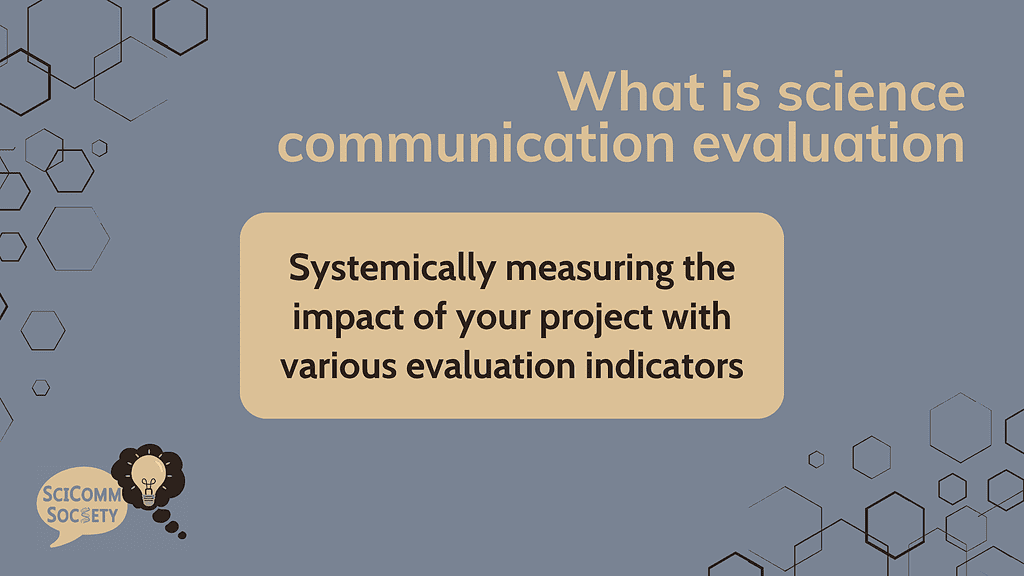
Second, you will need to find a way to systematically measure the impact of your project. These measured indicators compare your intended goals with the actual numbers and help you understand whether you achieved your goals and whether your project is effective.
Now, having understood what science communication evaluation is, let’s look at what exactly you can learn from these results.
Broaden your science communication impact beyond likes
When you start evaluating your project, you shift the focus from project outputs, like the number of posts, podcast episodes or events, to its impact, a change in some sort. This includes your target audience changing their understanding, behaviour, emotional response or attitude towards the topic.
However, there is always the risk of your audience misunderstanding your message, leading them to change their behaviour in a way that you did not intend. Hence, if you aim to inform or influence your audience, you have the responsibility to check for the benefit, harm or miss of the key message. It is not box-ticking but rather a duty of care.
For example, if your goal was for your target audience to start acting in a certain way, you would need a way to follow whether they are doing it. Only then can you learn whether your project had an impact or not.
Use resources wisely and more efficiently and decrease friction
Depending on the nature of your science communication project, you may have certain resources available. Before starting your project, take everything accessible to you into account. This includes financial means, software, technical equipment and manpower, such as your time and mental energy.
By constantly evaluating your science communication project, you ensure that these resources are used efficiently. You surely don’t want to waste anyone’s time or money on tasks that have no impact.
So, by learning about what works and what doesn’t, you can align everyone on the team to focus on the right target audiences, channels, formats and frequency. This also makes sure everyone sticks to the key message and is aware of their role.
Depending on the outcome of your science communication evaluation, you can reallocate resources, like manpower, towards those tasks with the highest impact. Keep following the mantra “stop what doesn’t work, scale what does”!
Improve your science communication project
Every time you get feedback on your science communication effort, see it as a way to improve the project and not as a verdict. Failed attempts or mediocre results are – just like in the scientific world – a result. As each indicator tells you what works, what doesn’t and what people like, use them to make the project and its outcomes better.
Evaluation also tells you whether everyone whom you want to reach actually gets your message. Based on that, tweak your project to be more inclusive and reach those for whom the project is intended.
After you have been on your project for a while, create a replicable protocol for each task related to the project based on regular project evaluations. Even small learnings and improvements help you redefine and adapt your science communication strategy, always according to your core values. This ensures your project stays consistent and of high quality and educational value.
Set transparent standards for science communication and advance the field
By creating an impactful science communication project, you are not only writing your own success story. You are also setting standards for the field and motivating other science communicators.
You could even publish your project evaluations in a journal on science communication to prove its impact with a wider community. Explicit evaluation indicators make the review fairer and projects more comparable.
Communicating what to repeat and what to stop and why can save others time and makes projects more consistent and easier to reproduce. Other science communicators will learn how the field is advancing, about best practises and which types of projects are of interest to the public.
By supporting other science communicators and providing them with better tools to create impactful outreach projects, more people get to learn about science. Hopefully, they will make smarter decisions based on science, eventually improving their health, the environment and society. And with this attitude, everyone wins.
Strengthen accountability, credibility and trust in science
As you are understanding and assessing which topics your audience is mostly interested in, you have the chance to create more content for them. This signals to your audience that you care about them, resulting in higher trust levels in you as a scientist and communicator.
Also, many funding agencies increasingly provide budgets for academics to engage in science communication or science outreach. Naturally, they then want to see that the money is spent on creating both scientific and societal impact. Even reports on what did not work in your science communication effort show transparency to both funding agencies and your audience.
In comparison, in the past years, we’ve seen that poor, inadequate or insufficient science communication risks preventing people from correctly using scientific information. Unfortunately, this can also damage the trust between scientists and the public, which is why efficient science communication plays a crucial role in fostering and mediating this relationship.
At the same time, acknowledging scientific uncertainty increases credibility and accountability. Being open about what we can and cannot infer shows scientific humility and builds trust. And we really need people to trust science right now.
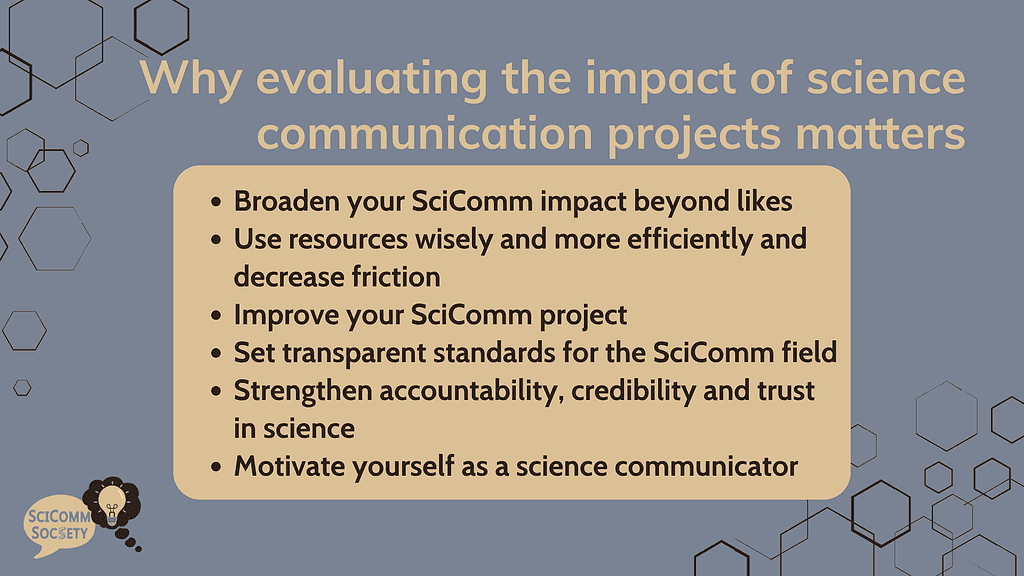
Motivate yourself as a science communicator
When you decided to start a science communication project, you probably had some goals in mind. Over time, these became clearer and maybe even tougher; surely no low hurdles to overcome easily.
You set yourself out to learn about both your scientific field and science communication. Maybe you even gained technical skills to get the project up and running.
When I decided to start a science blog, I had absolutely no idea about the technicalities behind a website. I learnt all about setting up and designing a website, science writing and blogging, social media and online promotion. So, how proud do you think I was when I finished and published the video course on “starting your own science blog” after having started from zero myself?
Similarly, seeing your own project taking off and having a clear impact on your audience can be a huge source of motivation. So, when evaluating your science communication project, acknowledge your own SciComm Journey (and feel free to write about it on our blog!).
You created a new science communication project whilst acquiring a new skill set and overcoming knowledge gaps. You were persistent and showed up for your audience regularly, sharing your passion with them.
I can only applaud that and ask you to use your evaluation results to keep learning about your scientific field and science communication in general! They will be great guidance for which topic to tackle next.
Why we need to evaluate science communication projects
As we’ve explored throughout this article, evaluating your science communication projects is essential for maximising its impact, using resources wisely and continuously improving your outreach efforts. By systematically assessing what works and what doesn’t, you both strengthen your project and contribute to advancing the entire science communication field.
Remember, evaluating your science communication project isn’t about judgement—it’s about learning, growing and ensuring that your passion for science reaches and resonates with your audience in meaningful ways. Start evaluating your project now with the FREE Notion SciComm Impact Tracker: Clarify your science communication goal, decide which indicators to check for meaningful progress and schedule your check-in to learn and adapt.