
When asking what prevents most scientists from starting a science communication project, I often hear that they lack the time. Yes, scientists are notoriously overwhelmed with research projects, grant writing, publication chasing and mentoring.
Yet, I think that it is not necessarily a lack of time but rather a question of how to manage it and organise one’s projects.
When I started diving into science communication in parallel to my research, I got quite overwhelmed by the number of projects that I decided to take on. Many of my research-related tasks already got lost between notes from lab meetings and ideas for experiments, conference deadlines disappeared only to surface at the last minute and drafts for publications and edits from co-authors vanished into email chains.
So, I knew I needed an efficient way to keep track of all the big and small tasks between experimental protocols and articles I was writing. By trying out different project management approaches, I built a system that works for me.
Why science communication project management matters
Over the years, I set up Notion (affiliate link!) as my project management system to track tasks and deadlines, write and collect articles, publish my SciComm portfolio, build a reading library and follow up on finances, social media posts and birthdays.
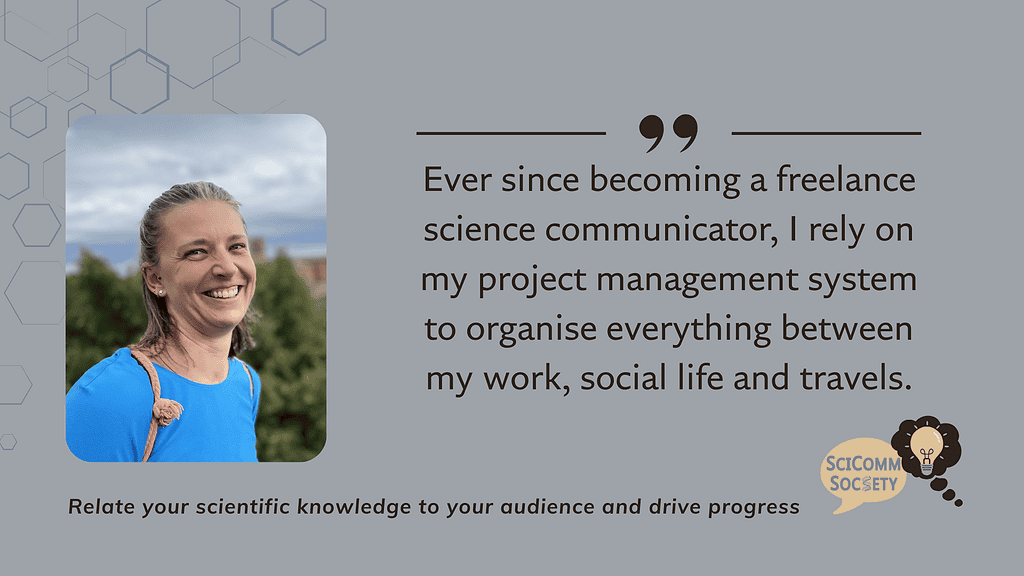
Especially since I became a freelance science communicator, this system has proved essential to organise my life.
As I originally set up this system to manage my outreach and science communication projects, I think a similar approach can also improve your science communication. It allows you to follow each step of a project, so you always know what to expect, what to focus on and which resources are available.
From the start, you can keep everyone involved in the loop, inform them on deadlines, budget limitations and next actions. Throughout the project, you can follow the necessary metrics to evaluate the impact of your project.
For me, one of the most efficient feature of most project management systems are repeatable workflows. They ensure that the project remains consistent and efficient.
Yes, I agree that at the beginning, the setup can be quite daunting and defining workflows and templates takes time. Only in the second iteration will you see the payoff as you don’t need to think about each step any more.
On the other hand, over-optimising may be a risk to creating too much task management. That’s why I am convinced that you need to understand for yourself which strategy to follow and how to set up your management system.
Science communication projects researchers may need to organise
In the blog post “Boost your mental capacity and manage your research projects with an Intray” on the Sunny Scientist, I talk about different options of how scientists can organise and manage their research projects. Here, I want to give you some ideas on how you could organise your science communication and outreach projects more efficiently to improve outcomes and make a real impact on your audience.
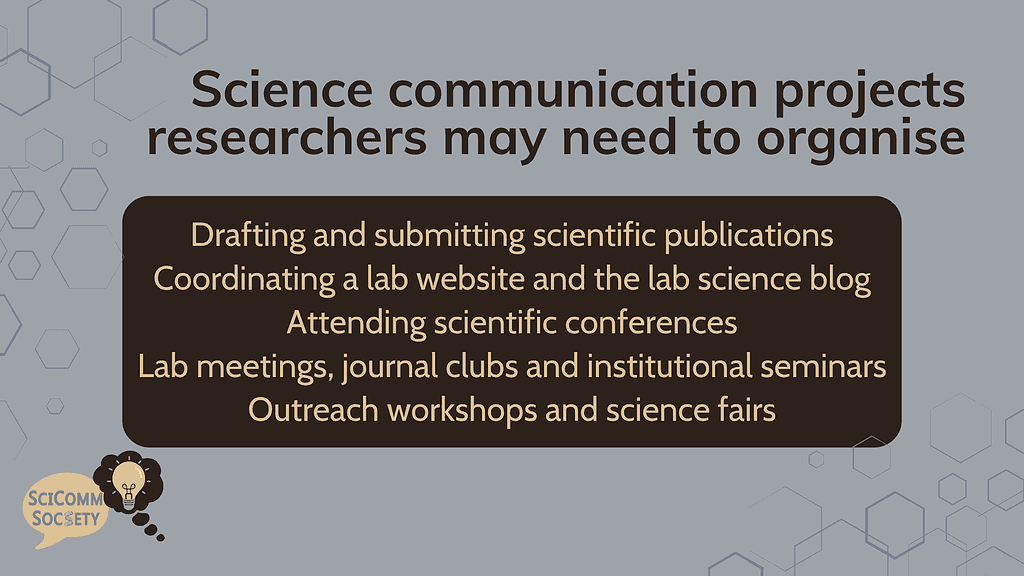
Drafting and submitting scientific publications
For scientists, writing and publishing scientific publications is a complex task: you need to create the different sections of the publications, the figures and their captions, the reference list, a letter to the editor, a lay summary and graphical abstract. Plus, getting all of them edited and approved by each contributor can be a collaborative challenge.
One idea is to keep all of the section drafts, their statuses of progress, comments, sign-offs and final versions in one project management system. Like this, everyone knows where their input is needed, what the progress is and which step to expect next. As the main currency of scientific success, the publication submission process should be high up on your list of projects to manage effectively.
Writing and updating a lab website and coordinating the lab science blog
An engaging lab website showcases the achievements of a research group, attracting new lab members and educating non-scientists on ongoing research. And as you know, I am a huge fan of science blogs to share scientific knowledge with the world.
Since both the lab website and a blog are quite complex and involve several people and tasks, they require efficient management. Only then can you ensure that a website visitor gets the right impression of your research group.
Within the project management system, set up a repeatable template for the publication workflow: draft, edit and save the content of the entire website, including the blog. Add and tick off tasks, follow the progress of blog post drafts, illustrations and social media posts.
This ensures that the output is consistent, readable and accessible. Measuring and tracking interactions and feedback on each post further helps you evaluate its real-world impact. Check out SciComm Society’s free Notion Tracker to ideate, draft and publish your science blog posts.
Attending, contributing to and networking at scientific conferences
Attending scientific conferences often requires a lot of organisation and approvals. Abstract submissions and their deadlines, applications for travel grants, keeping track of the budget and reimbursement paperwork are important tasks that are easy to miss. When it later comes to booking the travel and accommodation, commuting to the venue and registration, you also need to keep track of each step as well as confirmation documents.
And if you get to give a talk at the conference or present a poster, I can only recommend you save slides, figures and feedback on the talk in one management system. When you later need to give a similar presentation, go back to your notes and take it from there.
I am also a big fan of organising both notes from the sessions and fellow scientists and speakers in a simple overview. Later, you have a clear idea of whom you talked to, their presentation titles and interests as well as ways to contact them to follow up. As such, an efficient project management system can make scientific conferences an easy and carefree ride.
Lab meetings, journal clubs and institutional seminars
Ongoing scientific education and collaboration entails regular lab meetings, work-in-progress seminars or journal clubs. These are generally organised either within a research group, a cluster of groups or the institute.
Either way, scheduling the seminar series, confirming time and location, collecting the speaker’s details and presentation titles and sending reminder emails to attendees requires comprehensive and repeated organisation. In this case, master templates listing tasks and deadlines help organise these meetings, making the process reliable and faster.
Outreach workshops and science fairs
Another important and complex outreach project involves open-research days, science fairs or similar grand events organised by a research institute. Their organisation requires several diverse tasks, with the most tedious ones often slipping one’s mind.
That’s why efficient project management helps scientists manage these outreach projects. Setting up the agenda, organising stalls, topics, materials and experiments, creating handouts, feedback forms or evaluation questionnaires and keeping track of the budget should all be collected within one comprehensive dashboard.
An efficient project management system will also help you manage drafting and publishing social media posts, emails and press releases to share news on the event.
Start organising science communication projects alongside your research
At the beginning of my science communication journey, I was quite overwhelmed by the scope of my ideas. Only as I sat down to strategise the reach and goals of my projects as well as the needed tasks, it all fell into place. Breaking up huge projects into smaller tasks helped overcome my anxiety and turn it into confidence.
That’s why I am convinced that efficient project management based on a clear vision can help every scientist advance their science communication projects. Creating a master workflow with task lists for repeating projects ensures that the output is always of high quality. Yet, you can adapt these workflows to improve the project and make sure you reach more people with your science.
You can also share relevant data and tasks with those involved. From the beginning, everyone has an idea about what needs to be done, what to approve and by when, and what resources are available. Everyone is aware of their responsibilities and can organise other projects and tasks to prevent overwhelm or rush.
Another feature of an efficient project management system is the so-called intray, introduced by David Allen in his book “Getting Things Done”. This relies on you capturing your ideas and tasks quickly into the so-called intray and later taking the time to clarify their nature. As you reflect on the idea, you decide whether and how to flesh out the task, what needs to be done and how to take action. Get a sneak peek into what my intray looks like with this FREE Notion template.
Lastly, as we have learnt in “Why evaluating the impact of science communication projects matters“, tracking the outcomes of our projects in a dashboard is also essential. That’s why I’ve created the research-friendly FREE SciComm Impact Tracker for you to understand whether your project reached its goal and made the impact you designed it for.
How do you efficiently manage your science communication projects on top of your research?
We’ve seen throughout this post that managing your science communication projects relies on many features and tools. As said before, everyone needs to create their own strategy to organise projects and tasks. Here, I wanted to give you some ideas on how efficient organisation can make your science communication projects more consistent and impactful.
But now, I would love to hear from you!
What project management tools or methods do you prefer to use for your science communication work? Do you have a system that works well, or are you still searching for the right approach?




One response to “Project management for scientists doing science communication”
[…] story of how you solved the latest research question using your analytical skills, how you set up a project management system in the lab or supported the last science […]