Nothing in the world is ever still.
Instead, everything is constantly in flux; energy is flowing.
Biological cells grow, migrate, mutate and die.
We move, we walk, we run, we act.
Based on evolution, all organisms always adapt, change and transform.
This means humans always change, the environment transforms, plants and animals grow and move.
Even life itself starts with the transformation of a fertilised egg to an embryo.
And science?
How do we talk about science?
We describe static facts, models, concepts, hypotheses.
We talk as if things are fixed and rigid; not moving.
But obviously, science is also in motion: every discovery transforms how we comprehend a topic, every experimental result is a transformation of chemicals and molecules and every time we close a knowledge gap we change our worldview.
So, due to the inherent transformative nature of research, storytelling is the natural tool to talk about and explain science, scientific findings, facts, models and developments.
Fitting science and storytelling together
I am sure you know thousands of stories. You heard and read fairy tales, sagas, myths and fables as a child, listened to audiobooks, played video games or watched films and series. Each one of these is based on a story, the so-called hero’s journey.
Each story transported you into a different world. You got to know its characters and started identifying with them and their emotional responses. You followed them—or just the hero—as they faced a grand challenge, one that was life-threatening or challenged everything they—and you—believed in.
Your hero could only overcome this challenge by learning something new, changing their behaviour or attitude or gaining help from supporters or mentors. You understood that they needed to undergo this transformation – otherwise, there would have been no happy ending for them.
Your research journey as a story
Now, let’s look at your research: You are the hero of your project. You certainly have several emotions throughout your day doing your experiments.
Your challenge? It’s probably (and hopefully!) not life-threatening, but rather a research problem or question.
To overcome your challenge, you need to take action, test a hypothesis, prove a concept or fill a knowledge gap. As you are analysing the experimental data, you are transforming your own comprehension of the topic. You change your understanding of the research problem, updating previous concepts and models.
Once you have solved the question, the story is complete, emotions settle down and you can enjoy your happy ending. Well, at least for this project.
Another way to look at the transformative nature of research is from the project itself: You study a certain object, which could be a person, protein, bacterium, virus, plant etc. This is your hero.
And your research question relates directly to the challenge your hero faces. For example, and in its simplest form, how people handle emotional outbursts, how a protein gets activated, how bacteria avoid antibiotics, how viruses spread to other hosts, how plants take up nutrients, etc.
What is the transformation? Look at the results of your experiments: They tell you how your hero transforms to overcome the challenge and reach a solution.
So, since your research journey, research project and stories all integrate the hero’s journey, I argue that storytelling is the natural language for science communication. Just as stories inherently describe transformations, scientific research inherently discovers and creates transformations.
As a scientist and communicator, it is your task to transform scientific facts into narratives. In the “Guide on using storytelling in science communication“, you will learn more about transforming your research object into your story’s hero and telling its journey based on your experimental results.
Stories transform how we comprehend the world around us
Another aspect of the transformative nature of science stories involves how we respond emotionally to them. Most emotions trigger change within us, always with the goal of improving our lives.
For example, when a story inspires interest and curiosity, we start engaging with the topic, aimed at understanding it better and filling our knowledge gaps. Also, the emotion of awe triggers a change in comprehension and behaviour, often based on transforming our worldview.
Hence, as your audience emotionally engages with your scientific topic, they become more aware and learn. And every learning moment – from ignorance to understanding, from confusion to clarity, from curiosity to satisfaction – is basically a transformation. That’s why scientific storytelling aims to trigger those emotions that drive this transformative journey.
For example, people’s health is inherently connected to emotions and transformations. Health education addresses topics related to disease prevention and promotion, detection of illness, therapy and treatment. As such, it aims to bring about behavioural changes in people, giving up behaviours that are detrimental to health, relieving negative emotions experienced during episodes of sickness.
As people follow a scientific guideline or therapy, their health can improve, which transforms their mental, emotional and physical health and thus their lives in general.
Lastly, effective science communication can also influence the transformative journey of our society, planet and environment. As we trigger our audience to change their behaviour towards each other or the environment, social life and environmental health improve. And that’s a transformative journey we probably all like to contribute to with our science communication efforts.
Where to showcase your transformative research with an engaging science story
As we’ve seen, both science and stories are all about transformations, change and advancement. So, the next time you talk about your research, make sure to pack it into an engaging and logical story and adapt it to your target audience.
Where to tell those stories? How about these opportunities:
The most obvious one includes scientific publications. As we’ve seen at the beginning, you are the hero of your research project. You certainly faced a challenge or two and tried to overcome them with different approaches. Tell these stories! Tell how you optimised your experimental setup, chased your data and transformed your research question into a new model, putting the pieces together to fit into a logical story (and then tell THAT story!).
The same goes for scientific talks. Studies showed that when we hear stories, our brain activity synchronises with the storyteller’s brain; we connect with them. This neural coupling is a literal transformation, so make good use of it when sharing your science in person.
Also during job interviews, convince your future boss of your ability to bring about transformations. Tell the story of how you solved the latest research question using your analytical skills, how you set up a project management system in the lab or supported the last science fair.
Since stories stick with us much better than factual information, teaching and education environments are great for storytelling. For example, living organisms are incredibly complex. So transforming them into stories featuring a hero’s journey makes it easier for students to comprehend and remember the topic. Also in educational games and graphical comics, visual analogies help audiences relate to the underlying scientific concepts if presented as stories.
As a scientist, you may also be in contact with policymakers; and what represents more change and transformation than creating policies? When talking to this audience, highlight how your science can change politics and how it improves, transforms and advances society.
You could make society as a whole or just one person the hero of your story. Talk about the challenges they face and how your research is the solution to their struggles; how it helps them transform and improve their lives. It may seem strange to frame your science in this way, but to make a real impact with science, you need to be bold!
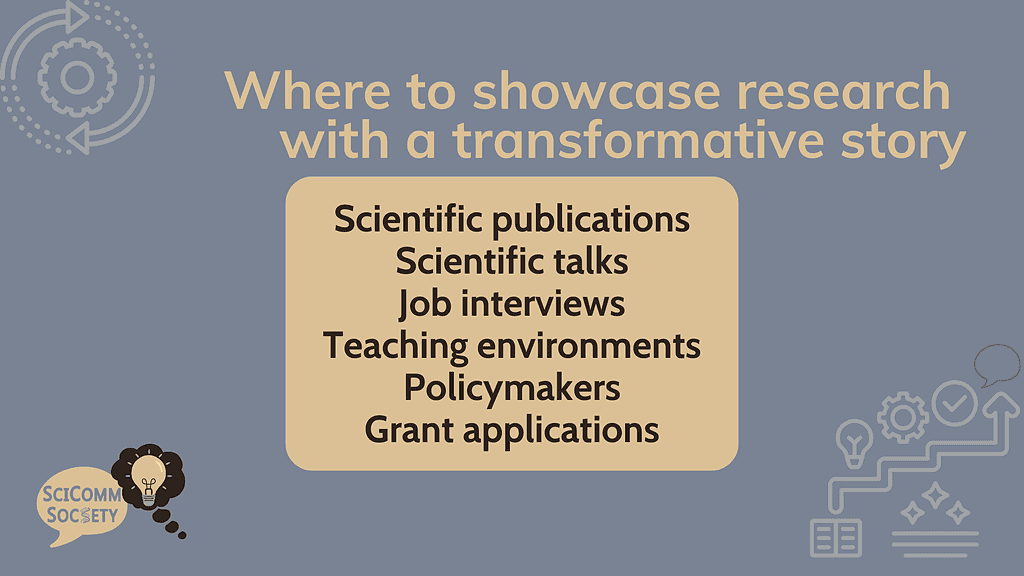
Similarly, when writing grant or funding applications, tell the story of how your science transforms the research landscape and society. Introduce the hero, your research subject or society, and its challenges. Even though you don’t have any experimental results yet, don’t hesitate to describe how they could solve your hero’s struggles or transform their life.
Every science story is a story of transformation — so let’s tell it
Throughout this post, I hope I could convince you that science communication is not just about conveying information—it’s about transforming our understanding, comprehension and action. Every scientific discovery, every research journey and every moment of learning represents a fundamental change, in us as scientists or in society as a whole.
Hence, storytelling is the natural language of science. So, let’s use it to talk about your research and the awesome things you discovered!
Because when we communicate science as a narrative, we engage our audiences and help them comprehend the very process that makes science meaningful. We take them on the transformative journey from question to answer, from unknown to known, from confusion to clarity. This is storytelling’s gift to science and science’s gift to the world.