What does repurposing content mean?
You decided to share your science with the world and dive into the exciting field of science communication. From your research, you created content for your target audience and published it on your favourite platform.
Maybe you wrote and published a blog post on your own website or recorded and uploaded podcast episodes to a streaming platform. Or you created social media posts for your LinkedIn profile or even wrote and published research papers in scientific journals.
It does not matter where or for whom you shared your research results. The important thing is that you have a lot of content available. You know a lot about your topic, with experimental results at hand and stories and visuals to explain it.
So, why not repurpose the content and publish it somewhere else as well, so others can learn about your science?
I am not saying to copy and paste the piece and publish it on a different platform. Instead, the idea is to use the key messages, stories and analogies and adapt them for a different target audience on another platform.
The goal is not to add more work to your already busy schedule. I want you to think about the most efficient ways to transform your content to reach new audiences with as little effort as possible. Use the content you already have and make it engaging and accessible for a new audience, so more people can learn about your science.
Why you should repurpose science communication content
At the beginning of your SciComm Journey, you probably started by creating one type of format based on your science communication strategy and core values. This is great, as it allowed you to speak to the same audience over and over. If the same audience comes back to you for more knowledge, it means your content speaks to them and they are learning.
But not everyone likes to consume the same type of content. I, for my part, have never liked watching videos and I only listen to podcasts when travelling or cooking (the latter I barely ever do!). Yet I’d always happily read an article or an explainer about an interesting topic or to understand something.
The same goes for your science communication content. By producing only one type of content and publishing it on one platform, you will only ever reach one audience.
So, to make an even bigger impact with your research, you need to diversify, or repurpose, your content. Make it available for a different audience so others can also learn about your science.
You already did the difficult part: you created the content in the first place. You researched the topic, came up with an engaging story to explain the science and probably found engaging analogies and examples from our daily lives so everyone gets what you’re talking about. Maybe you even created illustrations, like graphical abstracts or models, to explain your science visually.
This means you already have all the content. You only need to transform it into a format that speaks to your new audience and publish it on another platform.
This not only helps others find your science communication project online, but also strengthens your portfolio. Funders, collaborators or panel members will see the effort you’re making to reach as many people as possible with your science. This can open up new possibilities and collaborations for you.
How to repurpose your content
As we’ve explored, once you’ve created a piece of content, you can transform it into any format. You can use the same story, analogies and applications to explain the science.
You may have written a blog post, recorded a podcast, given a conference talk, created a poster, or submitted a grant application or research paper. Depending on your new target audience, you may need to make the piece shorter, break up the content or add more explanation. You will likely also need to adapt the visuals for that audience.
But which new content type makes the most sense for your piece? Which transformations are most efficient or require only a little time? Depending on what you have available, as well as your SciComm superpowers, some content transformations can be done easily. These are the ones you should focus on to reach new audiences quickly.
Below are a few examples of what you can repurpose your original content piece into. Note that these are solely ideas; you decide which new content type you feel comfortable creating, go along with your core values and which audience you want to reach.
Blog post
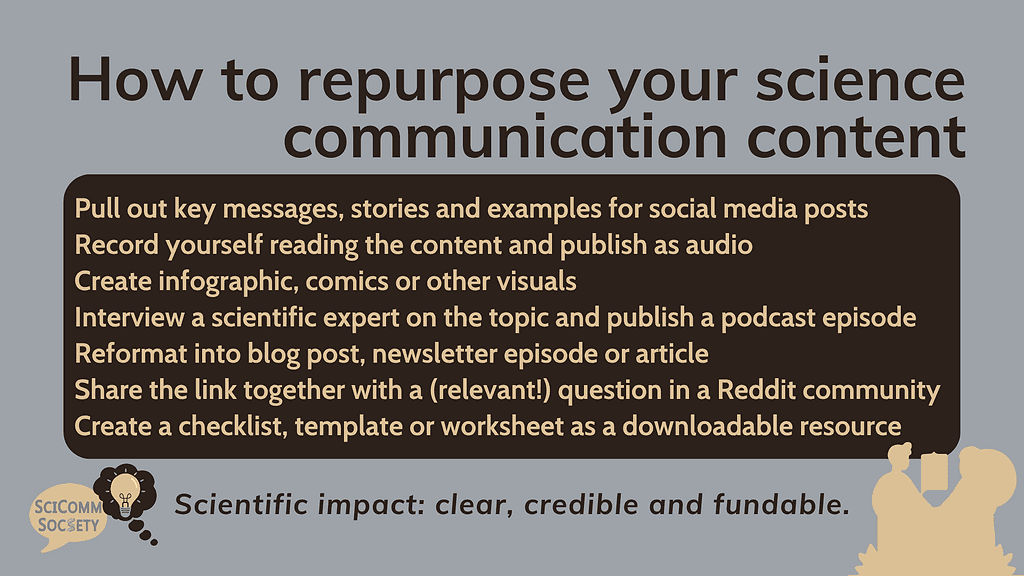
- Pull out key messages and create graphics with quotes for social media posts and carousels
- Record yourself reading the blog post and publish it as audio
- Create an infographic, comic or other visual material from its content
- Interview a scientific expert on the topic and publish it as a podcast episode
- Reformat for another publishing platform like LinkedIn, Medium, Tumblr or Substack
- Share the link together with a (relevant!) question in a Reddit community
- Create a checklist, template or worksheet as a downloadable resource
- Assemble a series of blog posts into an ebook or book chapter
Podcast
- Transcribe the episode and format it into a blog post for your website
- Take a snippet of the audio explaining a scientific concept and post it on social media with a description of the concept
- Share the link together with a (relevant!) question in a Reddit community
- Create a short video with captions using the audio and a simple visual background
- Pull out key quotes and turn them into quote cards or a carousel social media post
Conference talks & presentations
- Record the talk and republish it as an audio-only episode or video
- Turn key slides into a carousel post or social media post series
- Pull out the most important audience questions and use them for blog posts
- Reuse graphics and illustrations for an infographic
Posters
- Turn key results and visuals into a carousel post or social media post series
- Reformat the entire poster into an infographic for non-scientists
- Record a video of you describing the figures
- Transcribe the recording and reformat it into a blog post or popular science article
Grant applications
- Share lessons learned from the application process as a reflective blog post
- Reuse the project background and rationale for a popular science article
- Rewrite the impact section into a social media post series telling your audience why your research matters
- Use the illustrations and literature background for an infographic
- For a successful application, create a website to publish project news regularly
Research papers
- Adapt the abstract for a blog post, newsletter or social media post
- Reuse the references list as a mini reading list for a blog post, newsletter or thread
- Share the link together with a (relevant!) question in a Reddit community
- Use the visual abstract and key figures for social media posts
- Go on a podcast and describe your research paper for their audience
- Rewrite several of your publications together with other studies from the field into an e-book
Start repurposing your science communication project
Here I gave you several options for what you can do with your scientific content. Just as one experimental result serves as a building block for your entire project, one piece of content can be repurposed into other publications.
A strong piece of content contains several key messages, stories, examples and visuals that you can easily transform into new formats. With low effort, you can publish new content within 30–60 minutes. Medium-effort repurposing may involve light editing, designing or recording but should not take more than half a day.
I generally suggest prioritising low and medium-effort pieces to build momentum and save time. If you ever want to create bigger assets, like an ebook or website for your research project, schedule more time or reach out to a professional science communicator to help with this project.
Remember, repurposing your research project is not about being everywhere. It is about sharing your science in a format that best fits your audience. Thank you for sharing your science with the world!