Over the past years, storytelling became quite a buzzword in science communication. You’re told stories are the most efficient way to convey your expert knowledge to your audience. Science stories work both for your lab mates and your friends and family.
Perfect. Let’s tell stories about science.
But how can you create a story about your research project that helps people grasp the science?
What’s the key to creating stories that engage people and help them remember and care about the science?
Here, we will look at a recent study that investigated practical ways of making storytelling efficient. While adding narrative elements to science communication seems easy, they are not a recipe for an engaging story. Instead, one feature seems to make science stories more successful: transportation.
Why we need to tell engaging stories about science
Storytelling is a complex technique, by many even regarded as more of an art than a science. But efficient stories depend on several factors: from the form of the story, its length, plot, relatability, used metaphors, and so on.
These features are inherent to the story itself. And they generally influence whether someone perceives a story as “good” or “bad”.
But we also need to think about the recipient of the story, the audience. We need to integrate their background knowledge, values, beliefs and cultural background into our science communication goals.
Values and experiences shape how someone interprets information, especially complex topics like science. That’s why science communicators are encouraged to create content that is meaningful as well as emotionally and personally relevant.
At the same time, we need to stay clear that stories are not about influencing the audience to adopt the values from the story. The power lies in how well the values of the recipient are aligned with the values in the story. This is how we get someone to listen, become curious about the topic and want to learn more about it.
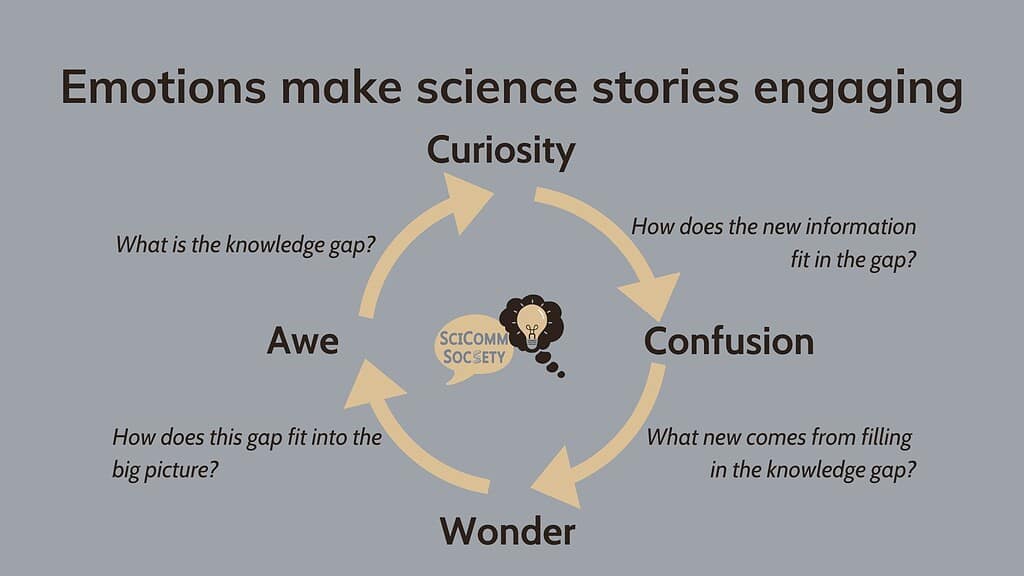
This is in line with what I discuss in “emotions make science stories engaging and meaningful”. Yet, a recent study went one step further and found that to create an emotional response, such as interest, in an audience, we need to immerse, or transport, them into the story.
Why story details matter less than expected
The study “What makes a good story? An empirical analysis of the factors that constitute “good” storytelling in the context of science communication” tested whether two known storytelling features, vivid imagery and the hero’s emotion, impact how an audience perceives a science story.
Before we get into the details of the study, I want to highlight the definition they used for an engaging and impactful story by Haven’s “Proof of Story” (2007): “A detailed, character-based narration of a character’s struggles to overcome obstacles and reach an important goal.”
To examine how recipients evaluated a science story based on two features, the study combined modelling with experimental group comparisons. Groups of people (together 570 participants) read different versions of a story, either as a fact-focused narrative, or a story containing visual images, emotional content or both of these features. Participants then evaluated the story quality on a scale from 1 to 10.
The results were not what the researchers expected.
About vivid images in a science story
To make sense of a story, the mind relies on imagery descriptions to visualise what we read or hear. This evokes emotion and engagement and helps us comprehend and remember stories.
One would think that visual detail in a story helps make a story “good”.
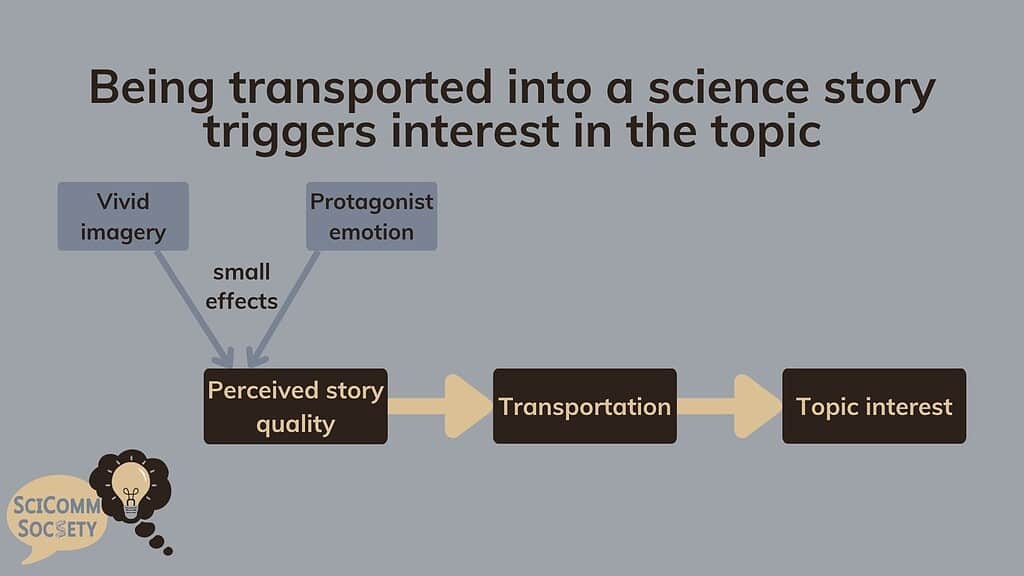
Interestingly, participants judged stories with vivid imagery only slightly better than stories without this feature or non-stories. This means stories with visual descriptions only have a slightly bigger impact on an audience.
Including a hero’s emotions and motivations
Second, they tested whether a story sharing the emotions and motivations of the main character had an impact on the perceived story quality. The idea is that learning about a hero’s inner perspective fosters connection, enhances immersion into the story and helps comprehension, as we tend to identify with characters with values similar to ours.
But again, participants did not agree.
They judged stories that include the hero’s emotions and motivation as only slightly better than stories without this feature or non-stories. Similarly, while including this feature in the story slightly improves its quality, it is not the deciding factor.
Being transported into a science story triggers interest in the topic
Instead, the researchers focused on another goal of storytelling: whether a story increases interest in the topic. And they evaluated this goal by whether participants got immersed in the story. This is what researchers call “transportation”: when following a story puts you into an altered state of mind, you become lost in the world of the narrative and leave the real world behind.
Researchers consider this a promising factor of how stories influence attitudes and beliefs.
Indeed, the study found that experiencing transportation helped foster interest in the underlying topic. By immersing yourself in the story, your curiosity and motivation to engage more with the topic increase. And as you find the topic interesting, you’re likely to invest more time, energy and effort to understand the material, remember the information and let it shift your beliefs and value system.
For science communicators, it means that adding narrative features to a science story is just not enough. But while transportation helps an audience become interested in scientific topics, it very much depends on the audience.
Education level and gender were associated with how immersed and interested recipients became, even though I think from a psychological perspective there is a lot more to discover. This, again, means we need to know our audience before creating science stories.
Two issues to flag here though: the study only measured how participants evaluated the quality of the stories. They did not modify the stories afterwards to check for changed perception. Since everyone evaluates stories differently, these results are rather indicative than definitive.
The researchers also did not look at any long-term effects of their stories. We do not know whether the stories triggered any behavioural changes in the audiences. But they do give us a first clue on what we can do to help audiences get interested in scientific topics.
So, how can you as a science communicator apply these findings and increase the chance of transportation with your science story?
How to transport your reader into your science story
Again, storytelling is more an art than a product of a scientific formula. The study shows that narrative features slightly improve perceived story quality while their combined effect seems stronger than single features.
But including narrative features in a story does not guarantee a desired response. We still need to tailor the story to the audience and their educational and cultural backgrounds.
Basically, we need to combine the approaches from the target audience guide with those from the guide on using storytelling in science communication. Luckily, you can download both guides for free!
Start where your reader is
The concept of the target audience pyramid is based on knowledge platforms and learning journeys. Evaluate:
- How much knowledge your audience has on the topic
- How long of a learning journey you want to take them in your pyramid
- The learning goals based on the length of your story, platform and available tools
Read more about the learning pyramid in “Understanding your target audience: The key to effective science communication”.
Use emotion as a meaning tool
We humans barely ever connect with scientific facts. Instead, we connect with the emotions that the scientific findings evoke in us. That’s why emotions are an integral part of every science story, so use them deliberately.
- Spark curiosity in your audience to hook them with the topic
- Create the right amount of confusion to trigger them to look for the answer
- Inspire wonder in your audience to drive their desire to understand and become passionate about your topic
- Create moments of awe for your audience to help them learn and care about the scientific topic
Give your science story an engine
Every science story needs action and transformation. With the framework from the storytelling guide, you can create the thread of your story based on your research project.
- The key player
- Its personality
- A challenge or struggle
- A life-changing transformation
- The solution
This story allows you to create a more complex narrative. It hooks your audience, makes them curious about your key player, asking for a solution and more information on the topic.
Use ABT to tell a logical story
Stories are only convincing if told in a logical manner. A simple framework of three parts helps you connect story pieces, so the narrative flows and your audience can follow easily.
- Connect two pieces of background information with AND
- Introduce a limitation, gap or problem with BUT
- Introduce the solution or new information with THEREFORE
Use imagery and metaphor to clarify, not to impress
Vivid imagery descriptions as part of a story help your audience make sense of the complexity of science. Metaphors create analogies to their world, thus bringing an unfamiliar idea into a more acceptable one.
But vivid detail and metaphors are only worth including if they truly help reduce the confusion and increase the understanding of the underlying science. If your goal is to sound more literate, there are other ways to achieve that than adding non-fitting and overwhelming text descriptions and metaphors.
How to tell science stories: Transport your reader
As we’ve seen here, storytelling is a promising strategy to convey scientific knowledge. But no one-size-fits-all solution exists to create the perfect, most engaging and efficient story about a scientific topic.
In my science communication projects, I see scientific information as houses in a village – depending on the complexity of the topic, the village is smaller or bigger. My role as a science communicator is to lead my audience through that village on the most efficient and engaging journey. I show them which houses are important for my story, that they need to look at.
At the end, I want my audience to have the best understanding of that village so they can decide which house to check out next; which topic they want to learn more about in the next step.
If you’re now keen to create your own story about your science, make sure to check out the free guide on using storytelling in science communication. I am looking forward to seeing the journey you take your audience on!