If you are a scientist who is just getting started with science communication, you might already feel the pressure: explain complex science clearly, make it engaging, create visuals and post consistently. And all of this, on top of research, teaching and everything else.
But science communication does not mean you have to do it all by yourself. In fact, the most impactful blogs, video channels, podcasts and outreach projects are usually built by teams, not lone geniuses.
A collaborative science communication project lets you share the load while improving the outcome. You can lean on someone else’s strengths, whether that is storytelling, design, editing or project management. This allows you to focus on the part of science communication you do best.
With this post, I want to remind you that if you feel overwhelmed by science communication, it may be time to bring in other people. Together, you can create engaging science communication content so your project feels lighter, more sustainable and a lot more fun.
Why collaboration is the foundation of science communication
Like everything in science, science communication is barely ever a solo adventure. Think about magazines, blogs, video channels, science fairs… All of these long-term projects are the result of team effort. Several people with different abilities – or what I like to call superpowers – come together and create projects that would not have been possible if each of them had done it by themselves.
So, just as collaborations are important to produce high-quality research and scientific publications, they are essential to disseminate science. By working together, you will be able to create an amazing science communication project to highlight the importance of your research.
When I started the blog BacterialWorld, my goal was to publish fun and engaging articles about bacteria. But as I was writing the stories, I realised I was missing a visual component. Luckily, I met the artistic wizard Noémie online, a microbiology fellow like me who wanted to share the fascinating bacterial world with the macroscopic human world.
So, we started our science art collaboration, in which I would write the stories and she would create engaging visuals to go along with them. We often spend a lot of time brainstorming the narratives and illustrations to make the articles as educational and appealing as possible.
This science communication collaboration also took quite some pressure off my shoulders. I did not have to do everything alone any more. Instead, I could rely on Noémie for the creative, artistic part of the blog. And honestly, doing this big project together and seeing how it became more and more important to both of us also made it a lot of fun.
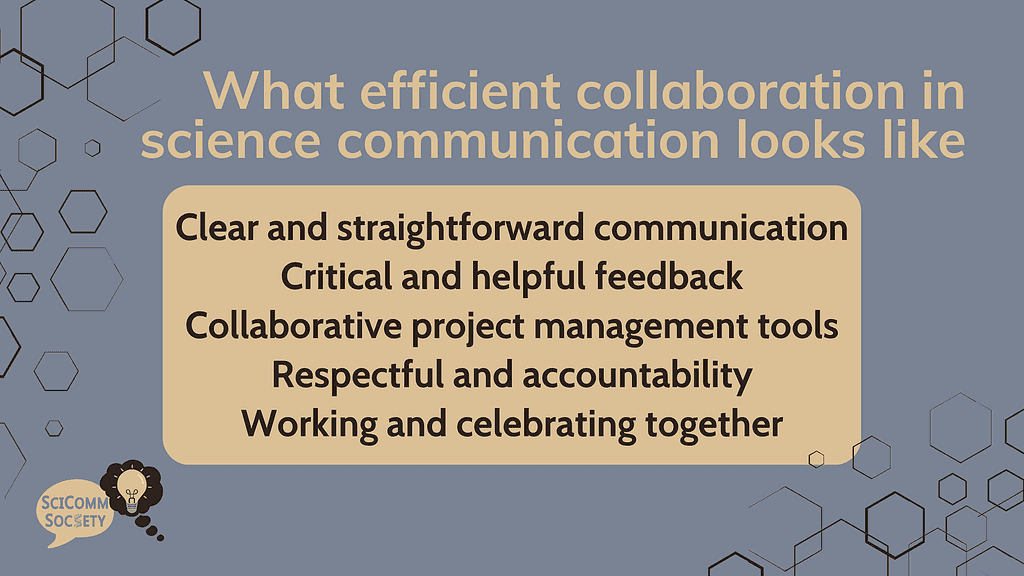
What efficient collaboration in science communication looks like
So, what does it take for a science communication collaboration to work? Like in any good relationship, it comes down to the basics: open communication, boundaries and mutual understanding. These are key to establishing and maintaining trust and strong relationships within scientific collaborations. But to make the collaboration really efficient, a few specific tools and strategies are also needed. Let’s dive right in.
Communicating clearly and straightforward
Just as science communication demands you communicate your research findings clearly and concisely, your internal communication should do the same. Using precise language, organising information logically and stating expectations and wishes clearly enables others to complete tasks effectively.
Active listening is also a crucial component of communication in all areas of life. When engaging in discussions or brainstorm sessions, listen attentively without judging what is being said. Wait for the other person to finish speaking before reflecting on what they said and formulating your feedback or questions.
When asking for help or input from your collaborator, try to be as specific as possible. Clearly state what you want, what “Done” will look like, which outcome you expect and whether there are deadlines to meet. This helps everyone organise their time and energy efficiently and the results will likely be closer to the expectations you set.
Giving critical and helpful feedback
Obviously, when different minds come together to create a project, there is a chance that the outcome is not quite what you expected. This is neither bad nor wrong. Sometimes we just comprehend things differently, especially when it comes to translating something as close to our heart and as complex as science.
If you are not happy with what your collaborator created, make sure to give helpful feedback. A comment like “This isn’t clear” or “Can you fix it?” is not helpful. The other person does not know what is not working or how it can be improved.
So, clearly state what the issue is and why it needs improvement. Something like “This jargon is difficult to grasp for a non-expert reader” tells the other person exactly what needs improvement and why.
Practical advice on how to improve is even better. In this case, you could add a phrase to substitute said jargon with. This open and helpful feedback can improve relationships within the team while ensuring the outcome is the best it can be.
On the other side of the table, when receiving feedback, make sure not to take criticism personally. Your work is being evaluated, not your ability or person. The goal is to create the best science communication content possible. And sometimes this needs a few rounds of creation, editing and optimisation.
Similarly, when asked for feedback on created content, don’t be afraid of being honest and critical. A “this looks great, no comments” can also feel unappreciative. Someone trusted your opinion and expertise to professionally evaluate their work. So, provide them with the requested feedback, even if it is just a few small suggestions.
Relying on collaborative project management tools
To make scientific collaborations work, I highly recommend using necessary digital tools to help with asynchronous communication and project organisation. This includes video conferencing software as well as a secure document-sharing platform. I am also a huge fan of digital project management platforms that enable collaborators across the world to work together seamlessly.
Using any project management tool, my recommendation is to keep and share one dashboard with all important information. Keep track of all tasks, creations, deadlines, helpful links and the budget for everyone to access. This way, all team members will be on the same page, as they have an overview of what needs to be done, what they are waiting for from others and when tasks are due.
Regular catch-up meetings help keep everyone on track, discuss progress and brainstorm ideas. They are also a great opportunity to strengthen the links within a team and improve workflows.
Creating a respectful and accountable working environment
Being part of a collaborative project also comes with responsibility and accountability. Some people need this to get things done. Many people are motivated by a little pressure to meet deadlines and do what they agreed to do.
At the same time, it is highly important to respect everyone’s ideas, opinions and boundaries. Just because you may not agree with someone’s idea for an illustration does not mean it is crap. This goes along with the part on giving each other helpful feedback. Everyone has a right to share their idea and opinion for a project, or bring in their views on what things can look like.
Working and celebrating science communication together
I talked a lot about how science communication collaborators should work together and how to make this most efficient. But collaborations also include celebrating achievements together. Every published blog post, podcast episode, video or infographic is worth a little “Well done us!”
Bigger achievements should be celebrated properly. When we published our colouring book, Noémie and I decided to have a glass of prosecco together in front of our laptops to celebrate.
We certainly deserved it after all this hard work. And so do you every time you share science with the world. So, make sure your science communication project also has room for the fun part of the collaboration. This builds trust and motivates everyone on the team to do their best.
Collaborative science communication projects to boost your portfolio
Science communication projects done in teams make great case studies for your portfolio. They offer real-life examples of your skills and the topics you have covered. Make sure you highlight them in your portfolio and include links, collaborators’ names and your role.
If you have data on the impact of your science communication project, add them as well. They show that you have an efficient strategy in place to reach your target audience and achieve your science communication goal.
Here, we discussed that if you want your science communication project to be sustainable, engaging and fun, do not just consider collaboration. Make it a must. Collaboration makes your science communication publications more consistent and increases its quality. Each person brings in their own strengths, from writing and illustration to project management and social media.
But for collaboration to work in science communication, you need to put in some effort: agree early on what your expectations are and what success looks like for you, communicate clearly, give specific feedback, be open to new tools to stay organised and hold each other accountable while respecting boundaries.
Make your collaboration work, so your science communication project will not only be easier, but also more impactful and joyful!