
As I write this blog post, I am sitting on a train. I am leaving my brother’s place in Southern Germany to see friends who live in the centre of the country. The travel time on the train is about 4 hours, which is optimal to work, be productive or just relax.
When I decided to stop working in a research lab, it was not just about not doing experiments anymore. I also wanted to become location-independent, so I could go and see the world while working anywhere and anytime.
Travelling and running an online science communication business
Starting a science communication online business gave me exactly this freedom: It allowed me to work at anytime and from anywhere. The only restrictions I have involve sticking to deadlines and showing up in online meetings. This at least gives my days some structure.
Funnily enough, one thing about being location-independent I did not see coming was how productive I get on my travels. When planning trips, I look at travel and journey times.
For some, a four-hour train ride sounds awfully boring; I, however, see myself working for four straight hours uninterrupted. Eight hours on a bus in a foreign country? Great! Time for several hours of deep-focused work, a snack break watching a film and another lighter productive session, all while marvelling at the landscape.
A flight or train is delayed for a couple of hours? With my laptop and tablet always accessible, I can get them out and start working at any point during the travel.
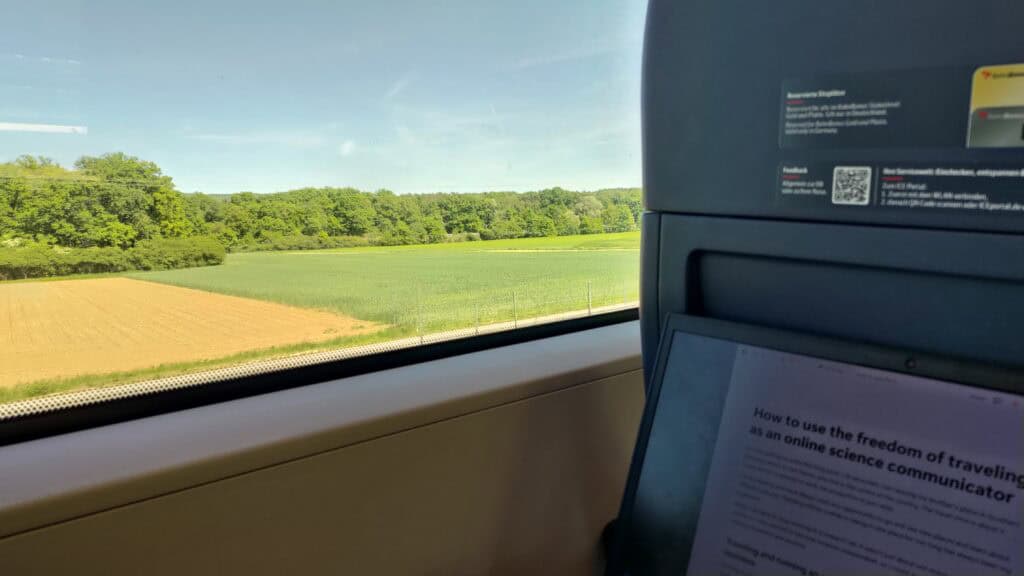
But what is it about working during transit that gets one into the flow? It might be the disconnection: Even though I have a portable router, sometimes data coverage is low, limiting access to email, social media and news feeds.
This disconnection provides me with the opportunity for offline work like planning, brainstorming, reading and writing. No distractions, notifications or colleagues. Your brain has just one job at that moment: the task that you decided to tackle. And if you need some rest or inspiration, just look out of the window.
How to prepare for travel productivity
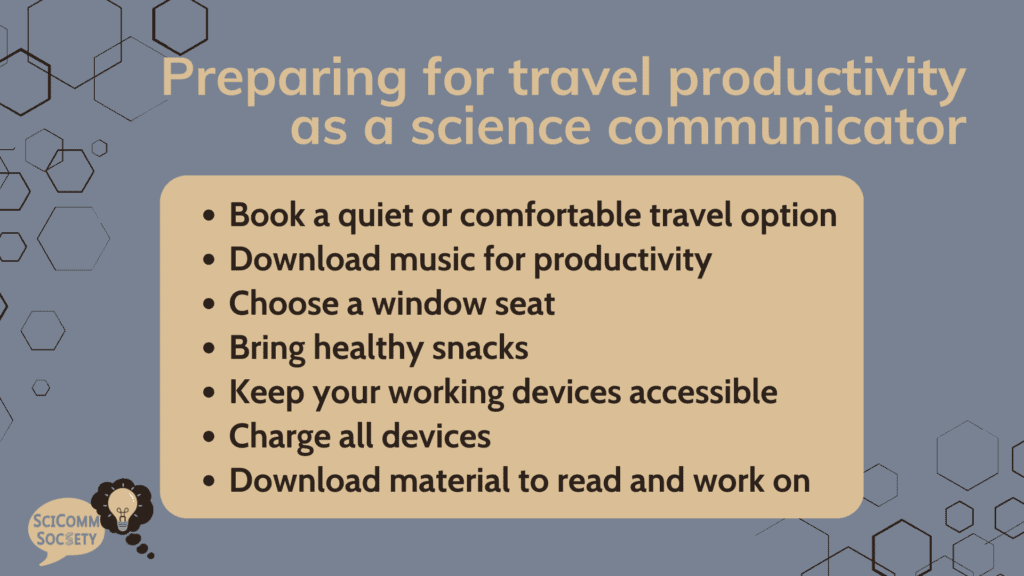
Even though you cannot expect to be highly productive during travel, it is important to give yourself the options to do whatever you feel like doing. This starts with the right atmosphere and preparation.
If you can, book a seat in a quiet cabin or some kind of comfortable option. This might include first class for a quiet environment with more comfortable chairs, a table and plugs to charge your electronic devices. Wearing comfortable clothes will make the travelling experience more pleasant.
To help you get into the flow, download music that makes you productive. Bring comfortable and noise-cancelling headphones which are fully charged.
Window seats allow more productivity since you will not have to get up if one of your neighbours needs to get out. Plus, looking out of the window allows your eyes and brain to rest while exploring the landscape.
Bring snacks so you will not get distracted when hunger strikes during the journey. Choose healthy food that does not leave stains, will not spill over your laptop or leave your fingers dirty or sticky. Otherwise, typing on your laptop will leave the keyboard disgusting.
When packing, make sure to put your laptop, tablet and necessary accessories in an accessible compartment instead of hiding them at the bottom of your bag. The idea is to be able to take them out easily and start working right away without having to unpack your entire bag.
All your devices need to be fully charged if you do not have a plug available. This includes your laptop, tablet, headphones, phone and powerbank.
To give you different options to work on during your travel, download several books, articles, reviews, podcasts, videos and music lists. This ensures you can still be productive in case you have no internet connection and it gives you several options to work on during your travel.
Which science communication project to work on during travel
While I never expect myself to be fully productive on a journey, I give myself different options to choose from on how to spend the transit time. When sitting down, I look around, check what I feel like and then decide what I’ll actually do with my time on board.
First, I turn to my task list. Many of my tasks entail writing or editing a scientific piece. Often these tasks can be done offline but might require full focus and absolute quietness.
Next, I look at my library since learning is still a necessity for science communicators. One reason I became a science communicator was so that I could keep studying different scientific fields instead of being stuck within my research niche.
Hence, I generally keep my reading library downloaded, overly packed, consisting of articles, literature reviews, podcasts, commentaries and books related to science, business-building and communication. This allows me to choose whatever topic I am most interested in at that moment. To me, reading and reflecting on what I learned is one of the best ways to spend travel time.
The third option to work on is an item from my project intray. This contains ideas for projects and tasks that I want to realise at some point. Travel time is perfect to strategise big and complex science communication projects and brainstorm their step-wise execution. It can also be a great opportunity to re-evaluate the idea list and scrap those that are not realisable anymore.
Today I was lucky. I felt the right motivation and energy to get started on a blog post on work productivity whilst travelling. Indeed, this idea had been sitting in my intray for a while.
What if motivation to work doesn’t hit during travel?
Please don’t get me wrong, I’m not saying that we have to work at all times. I am all for taking care of our mental health rather than working until burnout. In this post, I want to show you that using travel time productively can be a great option. But in the end, it is completely up to you to decide what to do with that time.
Maybe travelling for you means switching off your brain and doing nothing. There is nothing bad or wrong about that. Just do whatever feels right for you at that moment.
Plus, the right energy and motivation for deep-focus work may not be present during your journey. Maybe you’re getting super tired whilst sitting on the bus or train, or you have annoying neighbours who keep you from focusing. Don’t beat yourself up or start feeling guilty if that happens.
In that case, allow yourself to rest or let your mind wander. Maybe listen to music or a podcast, journal, watch a film, look out of the window or read a book. By resting and recharging your energy, you will be able later to create amazing scientific content for the world to learn.
It’s important not to put yourself under pressure. Avoid creating a to-do list for your journey since it would only fill you with guilt if you ended up doing nothing. Instead of expecting yourself to be productive during a journey, see it as an option.
What to do after a journey of deep work
If you managed to get work done during your journey, you’ve done an amazing job! Now it’s time to relax and give your mind a break.
Enjoy the place you arrived at, head towards the city to learn about the culture, go for an energising walk, have a delicious meal or catch up with friends. Enjoy the occasion that you did this trip for. You already got work done today, so allow yourself to get distracted and focus on something else.
As you set your brain to rest, also take care of your body. You may not have been in the best posture whilst working during your journey, with the laptop on your lap, shoulders hunched over a small table or sitting in an uncomfortable position.
Stretching helps your body relax, ease tense muscles and open up your chest to let air flow in unrestricted. Move as much as possible for the rest of the day, go for a long walk and avoid sitting for another long stretch of time. Your body and mind depend on each other. Taking care of one takes care of the other too.
Next, recharge your devices. You will need them soon enough.
Whenever you can, go back to what you worked on during your trip. Maybe you started putting effort into a new science communication project or task, so don’t let it go to waste. Make sure you realise the project, spread your scientific knowledge and help people become more aware of science.
Make an impact with science while travelling
Here, we looked into how using travel time for productive work sessions can be a game-changer for online science communicators. Whether you’re on a train, bus or plane, these moments of focused work can help you create impactful scientific content while exploring the world.
But remember that productivity during travel is an option, not an obligation. The key is to prepare without pressure, listen to your energy levels and choose the appropriate tasks for the journey.
For me, the freedom of location-independent work allows me to keep contributing to science and the scientific community. Maybe you have a similar vision for your life.
Maybe working as an online science communicator from anywhere in the world also fulfils you. In that case, prepare your travel bucket list, pack your electronic devices and bring your noise-cancelling headphones. Your next journey is just around the corner—being an opportunity for both adventure and scientific impact.