When was the last time you were in awe over something? Maybe an image gave you goosebumps? A fact surprised and overwhelmed you at the same time? Or a story made you rethink your worldview in a way that you decided to change a habit of yours?
We experience awe when we close a knowledge gap and discover something new whilst becoming aware of how huge the topic is.
As such, awe is a fairly frequent emotion in the scientific field. And as scientists, we are very much in awe of our research.
So, when we talk about our research, we should aim to trigger that same awe in our audience. This helps them both understand the science better and care about and remember it.
Here, we explore why science communicators should effectively implement this powerful emotion to engage audiences and help them learn about science.
Awe as an epistemic emotion in science
Awe is a so-called epistemic emotion; it’s the class of emotions that is related to knowledge, learning and information-seeking. The goal of epistemic emotions is to better understand the world to advance and improve our lives. You can imagine that with such a big task, experiencing awe can get pretty complex and overwhelming.
Other epistemic emotions are wonder, surprise and curiosity; all of which are closely related to awe. Yet, awe is somehow special. It is the grand finale of the learning process. As such, awe is the reason why many scientists enjoy the research process so much.
It is this bittersweet feeling when we learn something new and change parts of our worldview based on it. At the same time we understand how complex and vast the topic is.
This means to experience awe, we need to be aware of a gap in our knowledge, making us curious about a topic. By learning and getting new information, we’re not only filling this knowledge gap. We are also accommodating this new piece of information into our current understanding of the topic, adapting our mental models and shifting how we see the world.
This can give awe also a slightly negative touch: It can leave us uncertain about the topic or insecure on how to apply our new understanding of the world. It can also make us feel small within the big, eternal world. Yet, for most the positive aspect of this emotion takes over: We see the beauty of the subject, make new connections to others and to nature and become more curious about the topic.
The traits of awe
For science communicators to apply awe in their projects, we need to better understand how people feel the emotion of awe. Researchers found six structured traits that people mainly described when experiencing awe, some of which are closely connected. Yet, note that everyone experiences awe based on their own cultural history, interests, norms and values.
Vastness
When we experience awe, we often get overwhelmed by how huge a subject or topic is. This can happen when we look at an enormous mountain or a towering building or hear an idea or a scientific concept with enormous implications.
Or you may sit down and look at all the data from your experiments. It finally clicks, the pieces come together and you come up with a new model for your topic. Many also describe vastness as when they feel the presence of something greater than themselves.
Accommodation
The process of accommodation requires us to comprehend and transform an experience or a piece of information. Accommodating the awe-inducing experience or information closes a knowledge gap within our mental models and makes us see the world slightly differently.
Depending on how much effort the accommodation takes, this process can be quite uncomfortable. To adapt to a new way of thinking, we need to let go of the known and of how we understand a certain concept. Interestingly, some deliberately seek out experiences to challenge their understanding of the world.
Slowing down of time
Some people mentioned that they perceive time more slowly when experiencing awe. This is similar to how some people experience being in the flow state, which is when time tends to not exist when deeply focused on a task.
Self-diminishing
As we understand how big or vast a topic is, we may feel a lot smaller within the world. We may have a reduced sense of our own body size, with some people even mentioning that they would diminish completely.
Again, this may feel uncomfortable. Some even notice a feeling of insignificance within the world.
Connection
By being in awe over a vista, story or scientific concept, we connect to the awe-inspiring experience. This means we also connect to nature, the environment and to those around us who experience the same. Interestingly, this includes teachers and mentors who share the awe-inducing information with us.
Lastly, the feeling of connection may trigger a change in our behaviour based on the experience or information. We feel being part of a greater entity, which motivates us to improve the subject matter at hand. In turn, this aims to advance not only our own lives but also the lives of those linked to the experience.
Physiological response
You may also experience bodily responses when in awe. Maybe you get goosebumps or chills when looking at astounding landscapes or overwhelmingly beautiful subjects. Or you may end up with an involuntary facial expression when in awe: your eyes open widely, your jaw drops or you carry a bright smile.
Now that we understand what awe is as an emotion, let’s explore how science communicators can make use of this epistemic response to effectively convey scientific knowledge.
The benefits of using awe in science communication
As we have seen, epistemic emotions help people learn and care about new topics. With awe as the final of the epistemic cycle, science communicators should implement awe into their projects to help their audience get interested in science and change both their attitudes and behaviour.
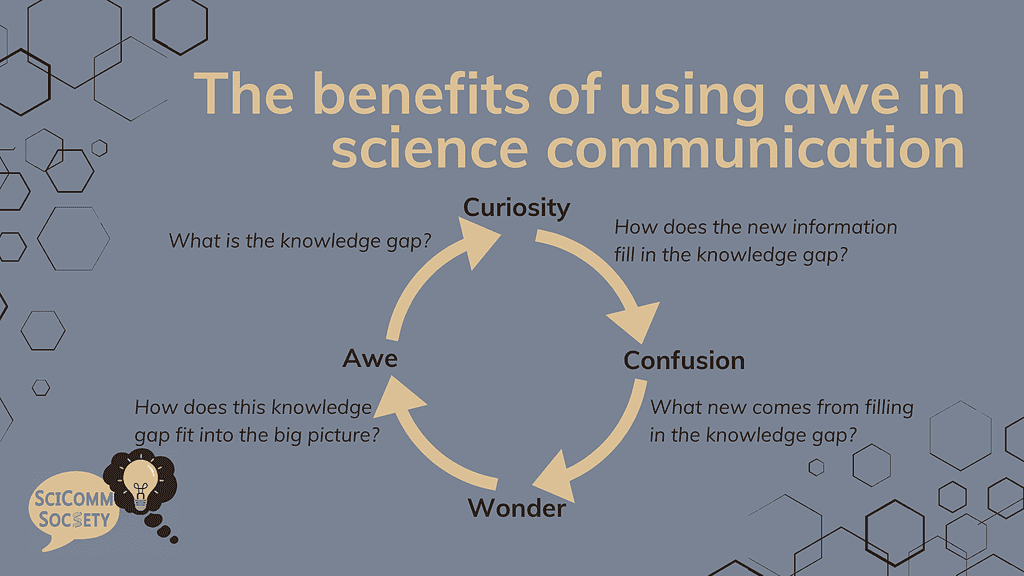
Many scientific theories and products are vast, either in their physical size or conceptual complexity. And comprehending such big and complex scientific concepts can leave us in awe. This especially happens when the subject matter is related to the audience’s lives or their interest.
Similarly, when our audience learns new scientific facts, they may need to revise their world views and accommodate the new knowledge. This adaptation process tends to be easier for people who are open to thought-provoking ideas and who acknowledge their knowledge gaps.
When in awe, people tend to connect on a deeper level with the scientific topic and nature. Therefore, as science communicators, we can help people care about science and everything it touches by implementing awe in outreach projects.
Furthermore, by feeling awe, people connect both to the scientific topic at hand and to those sharing the experience. This makes them trust the science communicator, scientists and thus science in general. And we really need that right now.
So, even though everyone has their own interests and passions, we as science communicators should aim to evoke awe in our audience by capturing and transporting them using engaging text, visuals and narratives that denote scientific findings or discoveries. As our audience feels awe about the world through science, they may decide to advance in it and help improve it.
Challenges and considerations when using awe in science communication
As I mentioned before, the emotion of awe can have positive and negative traits; it may feel awesome and challenging at the same time. On the one hand, awe provokes a sense of wonder and satisfaction when having closed a knowledge gap and comprehending the big picture.
At the same time, it can leave us powerless, small and uncertain. And we know that science often requires a high tolerance for uncertainty and ambiguity as well as a willingness to question our beliefs and knowledge based on new information. So, using awe in science communication can also overwhelm an audience, which is why we need to tread carefully with this emotion.
Also, not everyone experiences awe based on the same topics. As discussed earlier, awe is closely related to curiosity. Hence, people will rather experience awe on a topic that they are interested in than if they are not. Also, our cultures, values, norms and ideals mandate what we are curious about and feel awe for.
Another issue to consider is that whilst I deem awe highly important in science communication, we should not overly rely on it. Exploiting the wonders of science, praising scientific products as miracle solutions or glorifying scientific research can backfire and become manipulative.
Whilst science is fascinating in its own way, we should not hype it relentlessly. Rather, as communicators, we should put it into context for our audience and show them how it relates to their lives. Like this, they decide to connect with it based on their own interest and curiosity.
Why science communicators should implement awe
As a science communicator, I am highly convinced that implementing emotions in outreach projects helps our audience comprehend, connect with and remember scientific topics. One epistemic emotion, awe, is of overriding importance as it helps us make sense of the world around us to advance in it.
Studies showed that people who tend to feel awe in their daily lives are more likely to understand how science works and less likely to believe in ideas that science has shown to be false. Also, people who are more open to awe-inducing experiences have higher levels of science knowledge and academic success. This goes along with findings that people seek out information about the world through science based on their curiosity and interest.
So, as science communicators, we have the amazing opportunities to create engaging science stories relay scientific topics to our audience and get them curious and interested about their knowledge gaps. As we help them learn and make them aware of the big picture, we may trigger wonder, surprise and awe. Closing this epistemic cycle helps our audience see the vastness of the topic, its beauty and importance.
Finally, a successful science communication project would give an audience ideas on how to adapt their behaviour based on the new knowledge. This will help improve their lives, the environment and the planet. And this is how science makes a true impact.