As scientists, we are pretty used to talking in front of others about our research. Whether at institutional seminars, lab meetings, conferences or open days, public speaking is part of our job description.
But remember when you started in the academic world and how nervous you were about going on stage and giving a presentation? I am sure, though, things changed. After all, public speaking is a skill.
It is not about having talent, confidence, charisma or a loud voice. No, public speaking is the ability to communicate ideas clearly, so an audience pays attention, understands what you’re saying, remembers your message and applies what they learn in their daily lives.
So yes, I am convinced that we can get better at public speaking. And in this article, we will focus on three steps to achieve this: preparing a helpful presentation script, focusing on your audience and practising efficiently. Let’s get started.
Note that focusing on preparing your science talk assumes you already have slides for the presentation. If you need inspiration to create great slides, get the checklist with 5 principles for clutter-free science slides.
Prepare your presentation script
Now it is time to prepare your presentation script. Start from your key message: know exactly what you want your audience to learn and build everything around that very goal.
But writing a script does not mean writing an entire essay. I know it feels comforting to have every word written down in a document, but you came to TALK to your audience, not READ to them. And you won’t remember every word anyway.
Instead, put keywords and short phrases as speaker notes into the presenter notes of your slides. They guide you through the talk and remind you of what you want to say, while leaving you free to speak naturally.
Focus on your audience during your presentation
Now that you have an idea of what you want to tell your audience, think about how you can include them in your talk. This gives you two advantages: First, you shift your attention away from yourself and your body. For me, this tends to calm my nerves as I am not focusing on myself and my nervousness anymore but on an external factor.
Second, you want to involve your audience in your talk. They should not just listen to you passively. You want to connect with them either by involving them directly in the talk or by triggering an emotional response.
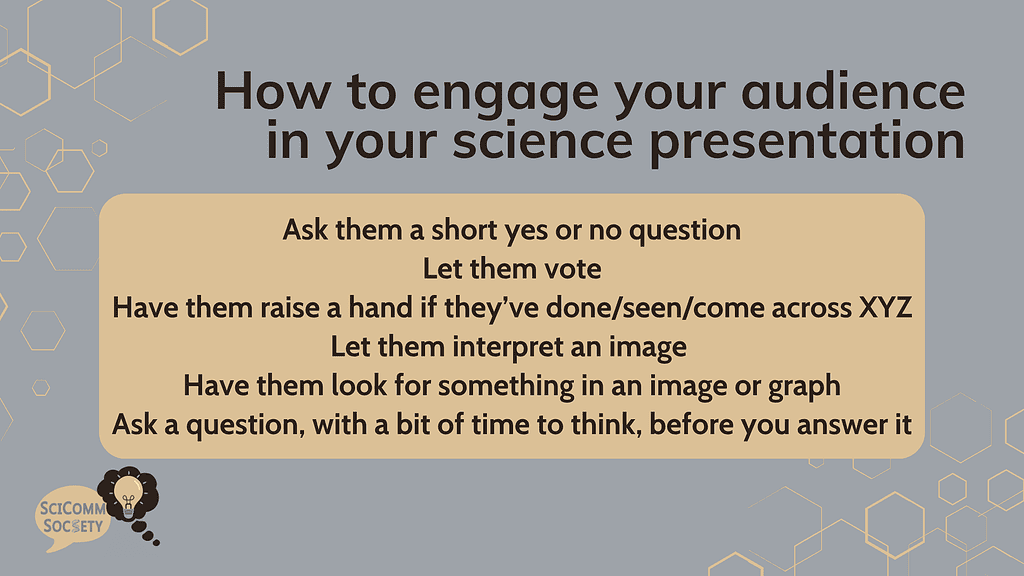
For example, you can engage your audience in your presentation by asking them:
- A short yes or no question
- To reflect on a brief question or discuss an opinion
- To vote
- To raise their hand if they’ve done/seen/come across XYZ
- To interpret an image or look for something in an image or graph
- A question, with a bit of time to think before you answer it
You can also engage your audience by triggering emotional moments, such as curiosity, wonder, tension, surprise and hope when it’s appropriate for your research. This is how your audience connects emotionally to your science and starts caring about it.
This may feel uncomfortable at first. But as a presenter, you want your audience to understand and remember something meaningful and to relate it back to their lives. This not only means sharing your science clearly and directly, but also that your audience should enjoy listening to and learning from you.
Another option is to use audio or video-based media. You don’t only have to show text or images on your slides. You can vary the media input if it genuinely strengthens your message.
These approaches can help you connect with your audience and trigger active learning. Your audience is not only listening; they also have the opportunity to think about and process what they hear.
Practise your talk efficiently
Probably one of the most efficient ways, though, to reduce your nervousness and gain confidence is to practise your talk. This will improve both your fluency and flexibility to talk to your audience. The idea is not to memorise the entire talk by heart, but its overall flow, transitions, concepts and key messages you want your audience to remember.
Bear in mind, though, that reading your script does not count as practice. Your mouth needs to actually form the words and your facial muscles need to make the proper movements.
This is especially important for non-native speakers, and I include myself here obviously. Some words, phrases, vowels and pronunciations may still trip us up because for our facial muscles, some movements are just not natural.
So, we need to make those movements intentionally and help our muscles get used to them. Only by practising the talk do the muscles and the brain learn and the movements become more natural.
To practise your talk, I want to share a few options and approaches with you here. But you need to find what works for you:
The simplest way is to try to explain what you want to say for each slide as you prepare the slides and speaker notes. You will see whether it makes sense or whether you need to adjust the slide. This is an easy and very powerful way of practising speaking.
You can also practise in mini-bursts. As soon as you finish preparing the slides for one topic or section, present that part in one go, either alone or with someone. This helps you understand whether the slides and sequence make sense, flow correctly or need adjustments.
To stay on time during your actual presentation, have a timed practice. Time either the entire presentation or sections. We all know how annoying it is if a presenter is talking for too long, so make sure you stay within your allotted time slot.
For high-stakes talks, I recommend you do a full dress rehearsal. Recreate the entire environment if you can. For example, present in that very room, stand up, connect your laptop and talk through the entire presentation without stopping.
Get a couple of colleagues or lab members or your mentor to join. Ask them for feedback, but make sure you do not take that feedback personally. They are there to help you, so use their criticism and feedback to improve your presentation.
Improve your public speaking and give great science talks
Giving presentations and talks is part of every scientist’s job description. It is one of the most efficient ways to share science and help others get it.
But speaking in front of others can make you feel very vulnerable. You may not like being the centre of attention or may be scared you will forget what to say. By preparing well for a presentation, you can lower these risks, calm your nerves and gain confidence.
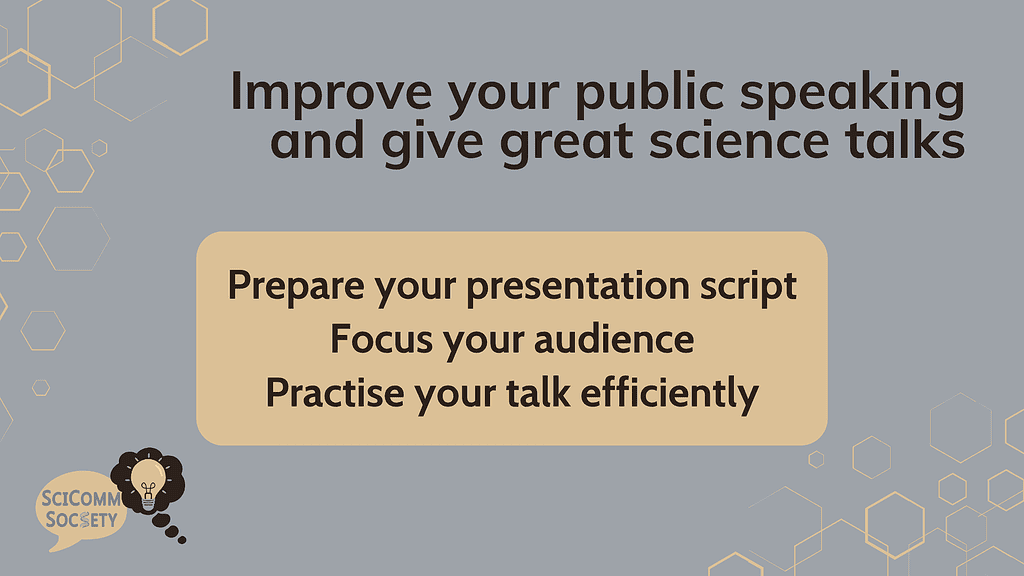
Drafting a helpful presentation script together with focusing on the audience and efficient practice will set you up for a great presentation. Knowing what to say, having a clear structure and starting to interact with your audience help you to focus on sharing your science rather than worrying about every word.
For more insights on this topic, our email course gives you lots of practical advice and approaches to prepare your science talk efficiently. You will go through daily exercises which will help you become a more confident speaker and give talks that your audience understands and remembers.