When talking to scientists about what keeps them from starting a science communication project, I often hear they lack time for it. And I get it. You are already overwhelmed with tasks related to your lab, mentoring, administration, publications, editing and conferences.
This makes it tricky to find time for yet another project. Especially since it requires you to learn new skills and establish new processes. But what if I told you that a few simple habits can make your science communication project lighter and less energy and time-draining?
During my postdoc, I decided to dive into the science communication world and start a few projects. Publishing a science blog required me to establish efficient and optimal routines and workflows on top of my lab work. Just like other projects and life tasks, I decided to prioritise it.
Here, I want to share some of the habits and mindset shifts that helped me run the science blog and reduce friction. These can probably make your science communication project also more sustainable and consistent.
Treat your science communication project like a hobby
When I say prioritise your science communication project, I mean to consider it a real project in your life, like a hobby. You probably already have other hobbies or life projects, like learning a language, practising an instrument, renovating or building a house or doing a sport. And you consciously set time aside for these projects.
For your science communication project, you should do the same. Make intentional space by establishing habits or routines around your project.
For example, when I started the BacterialWorld blog, I blocked two 2-hour slots per week in my calendar for the project. Just as I would do with my volleyball training. These slots were fixed, so I was unlikely to cancel them for anything of low priority.
Having these slots in your calendar prevents you from finding excuses not to work on the project. You are free at that very time, so you might as well put work into your science communication project.
Create a repeatable routine for science communication tasks
Another way to prevent friction around the project is by establishing routines and templates for repetitive tasks. For example, researching, writing and publishing a blog post always requires me to follow the same steps.
So, I created a template – or a checklist – that I always work through and tick off. This ensures that blog posts are consistent and of high quality. Plus I do not need to think about which step to focus on next. They are already written down and I can follow them like a protocol.
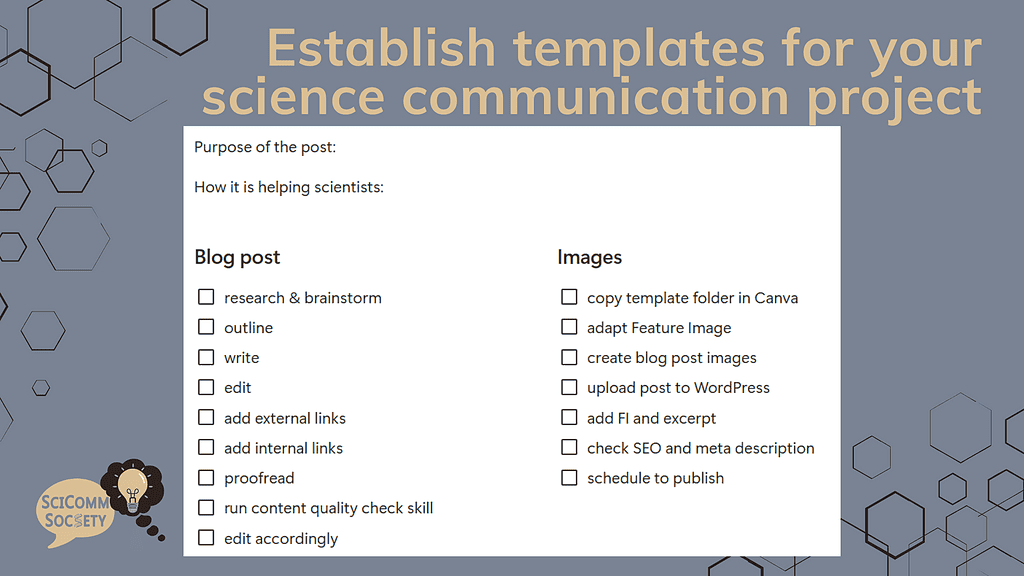
Another routine could focus on what you do after completing the task, like publishing a post. Especially at the beginning, creating a blog, writing and publishing posts can be stressful and time- and energy-consuming. Establishing a reward system can motivate you in the long-term.
Such a reward can be anything from a nice coffee at your favourite coffee place to giving yourself a break and going for a walk. Pick an activity you truly enjoy and look forward to while working on the task.
Improve your science communication skills
On top of habits and routine, sustainable projects also need input, inspiration and skill development so they can advance. If you play an instrument or practise a sport, you are probably always keen to improve your skills. When it comes to your science communication and blogging skills, I recommend to establish similar ways to keep learning.
One way to do so is by reading books, watching videos or listening to podcasts. You can also follow blogs on blogging. For example, many blogs and newsletters share the latest blogging tips to help you stay up-to-date on the topic.
Another way is to follow science blogs or newsletters from a similar or related scientific field. Like this you learn about different scientific topics while understanding how others blog. Reflect on what you like and don’t like about these blogs and what you could take over for your own blog. With this routine you also ensure your blog keeps advancing and improving.
Build an idea bank for your science communication project
I am often asked for ways to maintain ideas for blog posts. Honestly, it is pretty simple. I keep a list of topic ideas that I go back to when in need of inspiration. Even the smallest idea makes it to either my intray or the idea list as soon as it strikes me.
This process helps simplify one part of the blogging workflow: Ideation. Instead of having to think about or research a topic to write about, all I need to do is consult my idea list and pick a topic. That’s why I recommend to establish a similar routine and collect ideas from any source in one place; your blog idea bank.
Use feedback and questions about your research or blog posts
To collect blog ideas, listen to questions and feedback from anyone around you. Maybe family members, friends, students or scientists at conferences ask you questions about your research project or related topics. Jot these down and answer these questions in your next post.
Comments from social media or below your posts on the website also provide blogging content. People may leave comments, questions and feedback or ask you to clarify something related to the post. These are often great angles for new posts.
Maybe you came across someone else’s post or publication that you do not agree with or on which you have a different angle. Consider writing about this and explaining the topic or issue from your point of view. This also helps non-scientists understand how scientists handle disagreements.
Explain new research and general concepts from your field
Another way to keep your idea bank filled is by exploiting your research field. Some newly published articles are probably directly relevant for your audience. Or there are core scientific concepts from your field that they come across in their daily lives. These topics are generally worth writing about.
For example, a while ago I noticed the earthy smell after a refreshing summer rain. At that time I knew it was somehow related to bacteria, but had no clue really what happened or what they did.
So, I researched the topic and learned that indeed soil bacteria produce the substance geosmin that we smell when it rains. I found this utterly fascinating (like everything in the bacterial world really), so I decided to write a blog post about it.
The feedback on social media was great; lots of people were aware of the smell but never knew where it came from. It was amazing to know that my curiosity helped both me and others to understand the world a little better.
And if you are unsure which topic or idea to cover next, you can also ask your audience directly. Publish a question on social media, in your email newsletter and below your blog post on what they want to learn about.
Do not be afraid to ask. You might be surprised how many people respond to these messages. They are already following you, so they trust you to help them shed light on a topic they are interested in. Just listen to what they say and ensure you actually answer their question in one of your next blog posts.
Advanced tip: Use AI tools to organise your idea bank
While I am very much against using AI tools to write posts in science communication, I think they are of great help to organise projects and science blogs; for example to maintain your idea bank.
When you come across an interesting idea for a new blog post, have a tool check your posts for similar topics. After blogging for a while, you quickly forget about the specific topics you previously covered.
If it found overlap with previous posts, ask it how you could adopt the new idea so it fits the overall scheme of your blog while not becoming repetitive. This ensures you add links to previous posts and the new post has a unique angle while filling relevant topic gaps on the blog.
Run a sustainable science communication project according to your core values
Here, I gave you several ideas on how to establish systems to run and advance your science communication project, like a science blog, in a sustainable manner. Yet, everything you do, and all the habits you create around your science communication project, should feed back into your core values.
Being aware of your why makes the project truly sustainable and meaningful. Reflect on what the project means to you and why science communication is important to you. What is at stake for yourself as a scientist and communicator? Do you expect your reader to change their behaviour based on what they learn from you?
Knowing these answers helps you stay motivated and focussed on the project long-term. They give you motivation and passion to create meaningful and engaging science communication content.
Yet, they cannot remove structural constraints such as your academic workload, deadlines, institutional expectations or caring responsibilities. I am fully aware of that and don’t want to claim that I have a magical recipe.
What I want to do is give you ideas on how to establish sustainable habits and routines for your science communication project. Because if you prioritise the project and create great content, it is rather likely that your audience notices, learns and cares about your science.
To get more ideas into how to develop a science communication project sustainably, check out the SciComm Strategy Guide.