When you hear the term science blog, you probably think of a website-based blog with long articles, lots of technical setup and complex maintenance. And this is not completely wrong; this was the original idea of blogs.
As weblogs, companies and editors used to regularly publish journal entries to share the latest news and opinions from the field. These pieces mainly contained text; maybe screenshots to show technical details.
However, over recent years, the blogging world shifted. New blogging platforms emerged.
The way I see it and will use it for this article: anyone who is regularly publishing digital content in a consistent format and style on one platform on one particular topic is basically blogging. This includes social media posts, podcast episodes, videos, newsletters and articles. Obviously, the one factor that distinguishes a science blog from this definition is that it communicates a scientific topic.
This makes the sheer range of science blog formats overwhelming. And with new platforms popping up, it becomes even trickier to choose the most suitable for you.
In this post, we will look at ways to decide what is the best science blog format for you. Rather than choosing the most popular one, it depends on your own preference and on what kind of communication work you can imagine doing again and again. Let’s reflect on four factors that can make your science blog unique and sustainable.
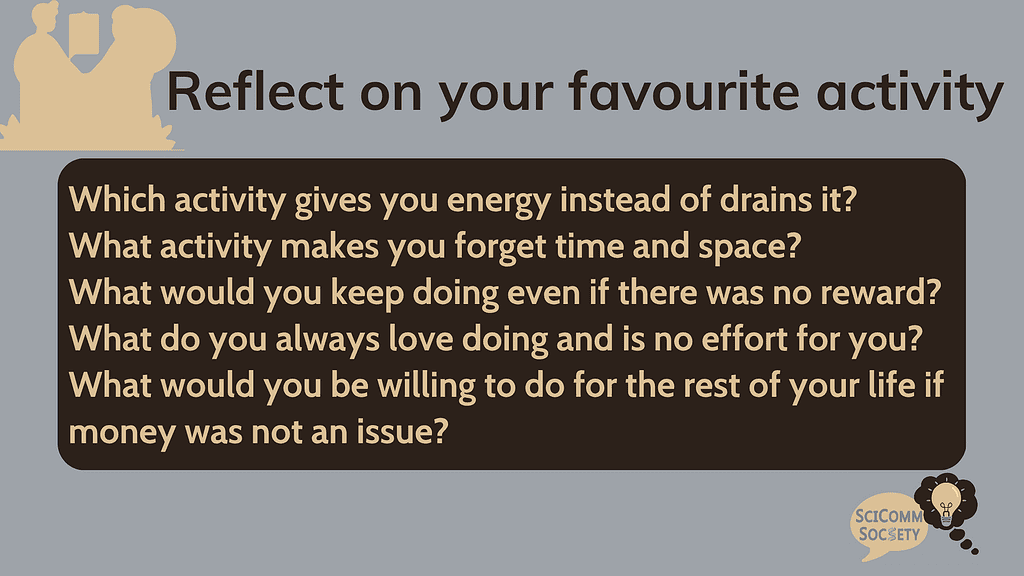
What activity brings you into flow state?
I love the concept of a flow state. To me it usually happens when I write on an interesting topic or brainstorm a new and exciting science communication project. It describes that state when you are highly immersed in one activity; when you completely forget that anything else exists.
Once done with the task, it is as if you wake up; you snap out of the flow state and realise you’re back in real life. Several hours might have passed easily, during which I am usually highly productive.
Maybe you know of an activity that naturally pulls you into flow state. Maybe you have several in mind. I call this your artistic superpower, or favourite activity.
To identify your artistic superpower, you can also look at it from the other side. How do you prefer to consume content? Do you get lost while reading, watching videos, listening, scrolling through social media or following public talks? This may give you an idea whether writing, filming, recording a podcast, publishing short-form or speaking would be your favourite activity.
Match your favourite activity to your science blog format
Having a better idea of what activity your science blog should rely on, let’s look at what it could look like. One note here, maybe you like doing several activities and want to use them for your science blog. That is absolutely great, please keep that vision.
However, I suggest you start with one activity and one format. Maintaining a blog requires work and dedication, which especially at the beginning can be overwhelming. That’s why I recommend to start a blog on one platform relying on the one activity that feels easiest for you. Once you have established a solid workflow for one blogging platform, consider looking into publishing on a second one, repurposing your content and reaching new audiences.
Let’s look at science blog formats based on your favourite activity:
You love reading and writing
If you are into reading long-form content, books, articles or publications, writing this type of content is probably your best option. Write articles and publish them on a blog on your own website, LinkedIn or as newsletters on publishing platforms like Medium, Tumblr or Substack. In these pieces you can really go into depth on a subject and describe scientific content from various angles.
You love scrolling and short-form conversations
Maybe you prefer publishing more in shorter time, sharing brief overviews over a scientific topic or research news. Then social media platforms like LinkedIn, Bluesky, Facebook or X are your platforms of choice.
You love visualising and illustrating
Most people prefer visual material since it is easier to process than written text. In this case, a blog on a visually focused social media platform, like Instagram or Pinterest, gives you the best option to explain scientific concepts with detailed illustrations.
You could also collaborate with a blog writer and create visual material for their articles. This is basically how we run the BacterialWorld blog. Honestly, it gained a lot more traction thanks to Noémie’s amazing illustrations that depict complex bacterial concepts.
You love listening and speaking
Lots of people love listening to podcasts while doing household chores or driving. And what could be better than providing them with engaging scientific content to listen to during their daily activities.
If you are happy to talk based on a script and endure listening to your own voice during the editing process, an audio-based science blog is your calling. You could start a podcast explaining a scientific topic yourself or invite scientific experts and interview or chat with them.
You love watching and presenting
Maybe you want to go one step further and not only talk to your audience, but also present to them. If you enjoy being in front of a camera, consider starting a video channel for YouTube, short-form reels for Instagram or TikTok or even webinar-style lessons.
For this format, you can decide between a wide range of visual material, voice and explanation styles and presentation formats. The only limitation for a video-based science blog is your own creativity.
You love community-building and reflecting
Many scientists and science communicators prefer to start a discussion with their audience on scientific topics. This is great and can be a huge source of inspiration for their research.
In this case, starting a newsletter, book club or resource digest might be a great choice. You could build an email list yourself and send emails to your followers. Or you start a newsletter on a social platform like LinkedIn or Substack.
Different publication formats require different levels of time and effort
Based on how much time you can afford on the science communication project, reflect on what type of content you could create regularly and how it fits into your already busy schedule. Obviously, the smaller the amount of information you share with your audience, the less effort you have to put in. Yet, lower effort does not mean lower value. It only means the format is easier to repeat.
For example, drafting, editing and publishing a high-quality social media post can take anything between 5 and 60 minutes. This means you could bring scientific content to your audience with only a little effort.
On the other hand, creating or drawing a scientifically correct and detailed visual can easily take a few hours, depending on the design. Publishing the visual along with a text description can add another hour spent on one publication.
A long-form blog post, article or newsletter can take several hours to even days, depending on the depth of the content, length and complexity of the topic. If you plan to publish the article together with one or more illustrations (either created by you or a collaborating artist), you need to take this time into account as well.
For a podcast episode, you need to plan and write the script, record and edit the audio and write and edit the show notes or transcript. As such, one episode can easily involve several weeks, depending on whether you feature a guest or have someone in charge of the editing process.
Creating a high-quality video requires the most effort and time. You need to plan and write the script, create visuals or slides, record and edit the video as well as edit captions. Again, you may have support from collaborators and artists, but one video can easily eat up weeks before its publication.
These are just the format-specific steps. For each publication, you also need to do research, which depends on how familiar you are with the topic you’re covering. Depending on the platform, uploading, formatting and publishing is more or less complex. Plus, after publication, you would want to promote the post, episode or video. So, drafting and publishing social media posts or announcement emails take up another bit of time.
Consider how much freedom over the blogging platform you want
While time and effort to publish a science blog is important to consider, another factor is how much the publishing platform allows you to do. For example, social media platforms are great to reach broad audiences. Yet, many constrain publication format, length, design and durability. Also, with consistently changing algorithms, you can never be sure your posts land in the feed of your target audience.
Instead, writing a newsletter gives you direct access to your audience. Yet, for someone to receive your email newsletter, they need to first sign up for it. This means, it is unlikely that someone accidentally stumbles upon it somewhere online.
A way to circumvent this issue are newsletter platforms like Substack and Beehiiv or blogging platforms like Medium. Your content could potentially reach anyone on the platform and the internet. Plus, they allow you to monetise your newsletter or blog and provide you with interaction tools to help you build relationships with your readers.
Similarly, running a podcast or video channel provides more discoverability while you can cross-post your content onto any platform. Once recorded and transcribed, consider repurposing your content into another format to reach those people who are not into listening or watching.
The science blog format with the most creative and editorial freedom, however, is your own website. You decide what the blog should look like, how long the content is, what type of content to publish, where to promote it and how your reader can interact with your content. Yes, setting up and maintaining a blog website requires more time and effort. This is why I created the “How to start your science blog” video course with detailed instructions on how to build, design and publish your website.
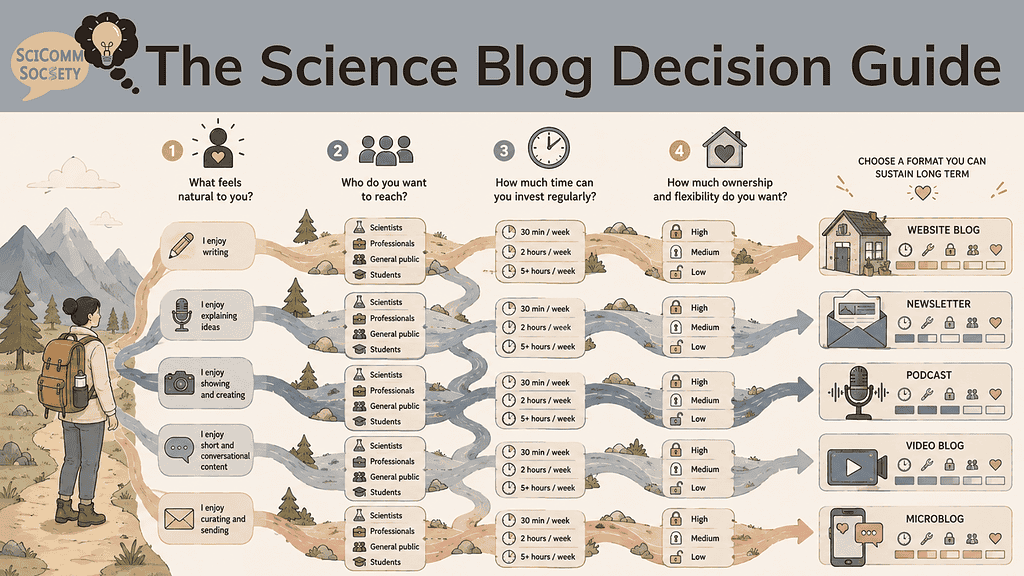
In sum, the amount of freedom you want over your science blog and its content directs which platform to choose. Take into account how you want to interact with your audience, how long your content should be alive, who owns it and who can access it. Whether borrowing readers from an existing platform or building your own community is in the end your own decision.
Which science blog format should you start?
Here, I gave you several options of what your science blog could look like and where to publish it. Especially at the beginning, this can seem overwhelming. You may also want to consider audience behaviour or are restricted by institutional policies. While the options I listed here can reduce friction to make your science communication project sustainable and engaging, none of these remove workload, audience-building constraints or platform limitations.
But I can assure you that if you decide based on what is important for you in science communication, it will already make things easier. Start with the format that feels most natural while keeping the scope small at the beginning.
Implementing your best science blog format will naturally fit your communication strengths, your audience and the amount of effort you can sustain. This supports motivation and passion for the project, so creating helpful and engaging content for your followers becomes easier.
If you are still unsure about which format to choose for your science blog, check out the SciComm Strategy Guide. I am looking forward to seeing you create a new science communication project to share your amazing research!