When you look around, everyone seems to be hanging out on social media these days.
People get information on their favourite topics from creators, organisations and communities they trust.
Even though the content format may differ, the psychological elements that stop someone from scrolling are similar.
People engage with and trust content that resonates with their values, sparks curiosity or helps them solve a problem.
And whilst this makes social media a great tool to share scientific knowledge with a global audience, it can be frustrating for scientists and science communicators.
There are too many platforms to choose from and it can seem like you need to be a designer, storyteller and marketer all at once.
But to build trust in science through social media, we need to use these platforms strategically.
In this blog post, we will tackle two questions: What makes science content impactful on social media? And how do you choose the right platform for your project?
At the end, you will also find a practical decision guide to choose the best social media platform for your science communication project. Let’s dive in.
What makes content impactful on social media?
When creating a holistic strategy for your science communication project, you are surely also including a strategy for social media. As support for your overall project, your social media strategy should rely on similar pillars. Yet, for fast-moving social media environments, you will need more empathy to link credibility with relevance.
Research shows that posts from reputable organisations and scientists, as well as posts that include visually appealing designs, graphs, facts and cited sources, increase people’s perceived trustworthiness of the scientific information.
This means impactful content on social media needs to be relevant, visually appealing and emotionally engaging. As a scientist, you may hesitate to use emotions when communicating scientific information, which is unfortunately why science-related information struggles to satisfy platform algorithms to reach wider audiences.
But there are other factors that make people read your posts and learn from your science.
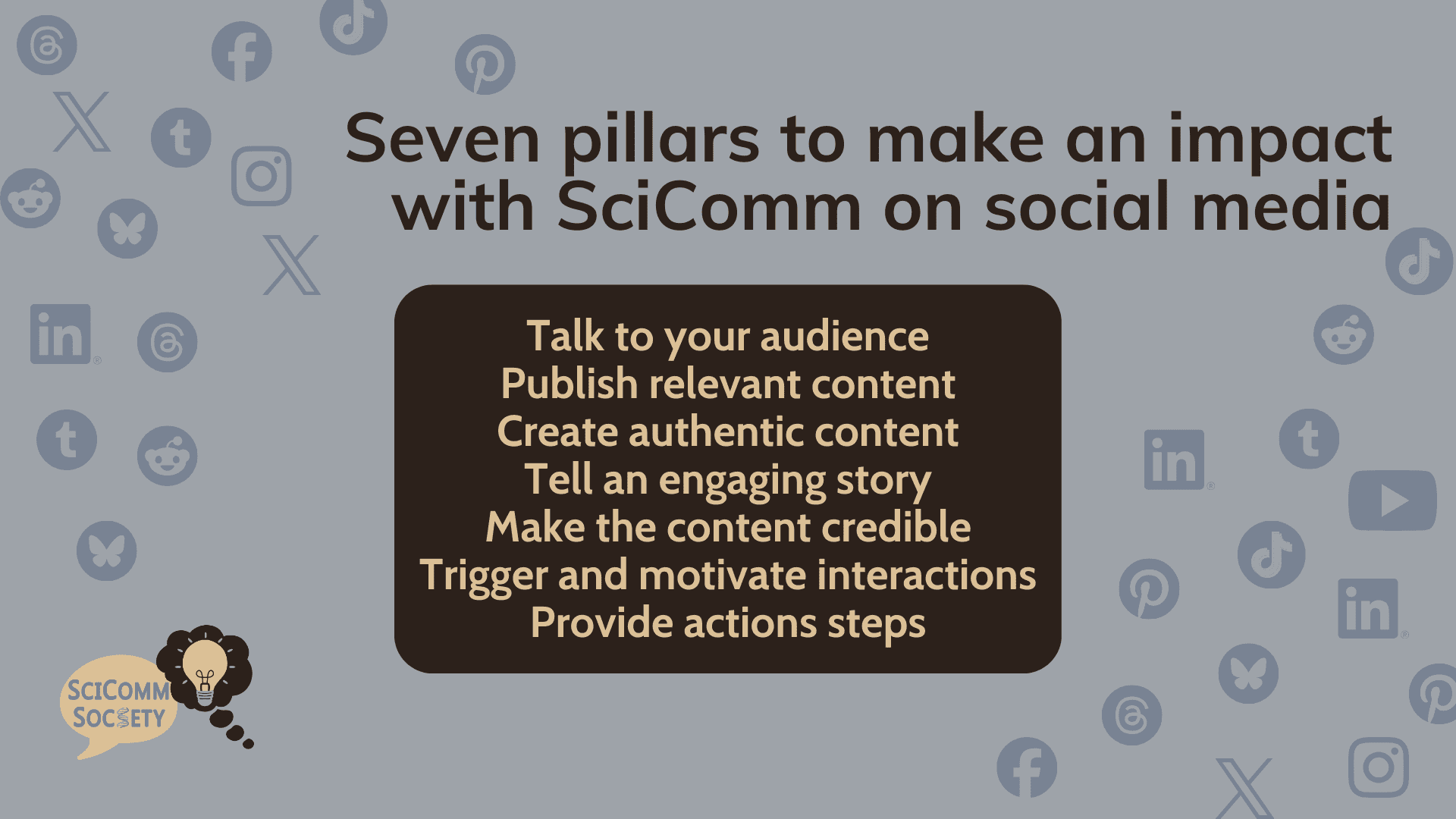
Talk to your audience
As with all communication projects, we can only communicate efficiently if we know our audience. We need to take into account how much our audience knows about the scientific topic and how much information we need to provide for them to close their knowledge gap.
Do you want other scientists to learn about your research? Or do you want to bring awareness on a topic to schoolchildren? When choosing a social media platform for your science communication project, think about the audience you want to reach, on which platform you may find them and what type of content they will likely engage with.
Publish relevant content for your audience
Being active on one social media platform (I suggest you start with just one!), your goal is to make your audience stop scrolling and read your post. To catch their attention, make the post interesting and relevant.
This means your content should show how your science impacts your audience’s lives and how knowledge from your post could improve their lives or solve their problems. Another strategy is to trigger knowledge-seeking emotions, such as wonder, surprise, curiosity or awe, to get them interested in your topic.
Evaluating the impact of your social media posts helps you find out what topics or formats best resonate with your audience. Based on these findings, you can optimise your posts so they will trust you and learn from you even more.
Create authentic content consistently
In the Science Communication Strategy Guide, I talk in depth about how important it is to create a project that you are actively passionate about. Your project should both be based on your core values and rely on your superpower. This will ensure that you are consistently motivated to create content and make an impact with your science.
Especially on social media, publishing consistently in a similar style and tone will help your audience recognise your content. After a while, they will trust you and apply what they learn from you in their daily lives. And this is how you truly make an impact with your science!
Tell an engaging story in your social media post
As you know, I am a huge advocate for storytelling in science communication. And I am convinced that social media posts should also tell stories so your audience remembers and cares about your science.
This means when creating your content, connect the different pieces of information logically so your audience can follow. Also, triggering epistemic emotions helps your audience engage with your content. Storytelling is really the only way to tell your audience how science could transform and impact their lives.
Make the content of your posts credible
As you are sharing scientific knowledge on social media, it is crucial to tell your audience where you got that information from. To make clear that your statement is based on scientific experiments and logical conclusions, add links to relevant sources, like research papers or expert interviews. This avoids misinformation and misleading conclusions.
Trigger and motivate interactions with your audience
By talking about complex scientific topics, you will likely trigger confusion and more questions in your audience. And that is totally fine. The key is to both be open to any type of question, concern and feedback and to respond to them in an empathetic manner.
Help your audience close their knowledge gaps and ease their doubts. Just by treating them respectfully and with positive intention, they will trust science and scientists a little more.
Interacting with audience-based questions and feedback may also help you better understand the relevance of your research or trigger new ideas for research projects.
Provide your audience with next action steps
As mentioned before (and I will keep preaching that), having a clear goal for your science communication project is crucial. What do you want your audience to do after they read your social media post? Having caught their attention, use the momentum to transform their interest, curiosity or trust into an action.
Do you want them to click on a link to read more in an article? Do you want them to be more aware of a certain topic or issue? Do you want them to interact with you or others from your field? Tell them clearly and directly.
Choosing the right social media platform for your science communication project
I hope you now have a better idea about what makes for an efficient and engaging social media strategy for your science communication project. Having a clear vision of how to create impactful social media posts, you now need to work out which is the best platform for your project.
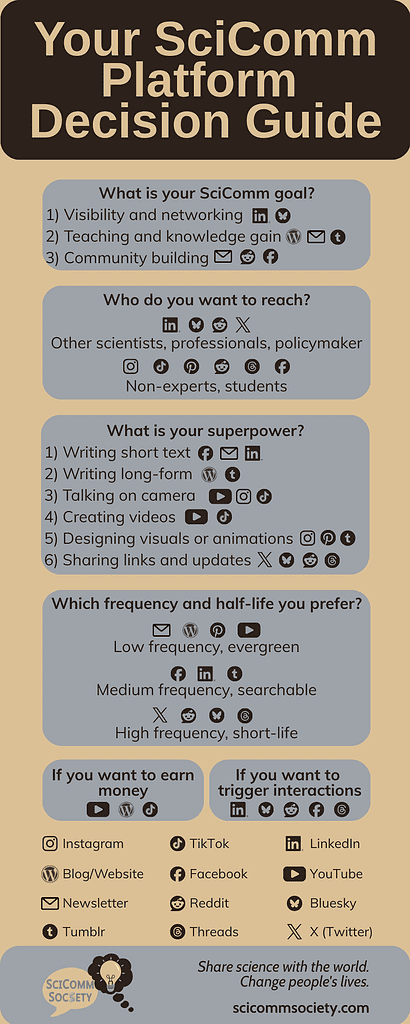
Each platform comes with its own perks and features and depending on the type of content you want to create, you may already be drawn to one or another platform. If still struggling, use our decision guide to choose a platform for your science communication project and read more about the advantages of each platform below.
LinkedIn has become the best for professional networking and thought leadership. It is ideal for career development, institutional announcements and reaching policymakers, other scientists or industry professionals.
Also, LinkedIn is the only platform used consistently across all age groups in academia. Similarly, results from our survey show that 77% of SciComm Society’s community prefers LinkedIn, whilst LinkedIn is also where I receive all of my invitations from clients and for collaborations.
Bluesky
The growing science community on Bluesky is great for those seeking a less algorithm-driven, more chronological feed experience. Bluesky is about exchanging, interactions and discourse on scientific topics and novel research.
Academics experimenting with Bluesky are not just browsing – they’re actively participating. This has transformed this new platform into one that is perfect for collaborations and building relationships with peers.
Instagram is probably the best platform for visual storytelling relying on images, infographics and short videos. It is perfect for making science accessible and engaging with younger, visually-oriented audiences in short and attention-seeking bits.
X (Twitter)
Whilst having lost a big chunk of scientists, X is still one for quick updates, threads and broad reach. It has always been great for sharing papers and research updates and engaging with the global science community in real time.
Even though lots of scientists left X due to changing ownership and eroding trust, others (like me) stayed whilst dialling down participation and use it solely to remain informed.
YouTube
YouTube is the best platform for long-form video content presenting in-depth explanations, tutorials and demonstrations. If your goal is to build a dedicated audience interested in detailed scientific discussions and visual learning and you’re keen to create videos or present in front of a camera yourself, YouTube is your go-to platform.
TikTok
This still relatively new platform relies on short, engaging videos with creative hooks. It is excellent for reaching younger audiences with bite-sized science content, research trends and quick explanations. People seem to be generally interested in any topic, but growing a dedicated audience is tricky due to the overall amount of high-quality and attention-grabbing videos.
As one of my favourites, Pinterest can be great for scientists if used correctly: it solely relies on visual discovery and idea curation through infographics and diagrams. If you are an artistic wizard, use Pinterest to share research visuals and educational graphics with the goal to drive traffic to longer content like blog posts or papers.
Facebook has always been about community building and group discussions. This hasn’t changed. This platform is still effective for engaging with local communities, organising science communication events and facilitating longer discussions on scientific topics.
As one of the oldest platforms, Reddit triggers community-driven discussions and niche forums. For scientists and science communicators, it can be a valuable platform for engaging with specific communities, answering questions and sharing and discussing research.
Threads
This new text-based social platform seems to be great for casual conversations, community building and sharing quick updates with an engaged audience in a less formal environment. I haven’t tried this platform myself yet, but this is what I gathered from different sources.
Newsletters
With academics diversifying their digital presence across smaller, trusted spaces, the trend seems to go towards more curated and personal engagement. This includes direct communication through subscriptions, via email or dedicated platforms such as Substack.
For those who aim to build a dedicated audience and have more freedom over content length and format, this might be the best platform to share in-depth scientific knowledge and maintain direct contact.
Which social media platform will you use for your science communication project?
I hope you now have a better understanding of different social media platforms and their strengths. Whilst you may already have your own favourite platform where you reach your desired audience, I at least wanted to give you more options.
Maybe you are already mastering one platform and are looking for another one to make an impact with your science. This may be the right time to reach a new audience and help them learn from you and your science. It is always a great idea to repurpose content on different platforms as long as you don’t overwhelm yourself with too much work. Just make sure to adapt your content to each platform.
So, if you are struggling to make the decision of which platform to start, have a look at SciComm Society’s Decision Guide for your best social media platform. Depending on the audience you want to reach and your goals and superpowers, this guide will help you make a strategic decision.
Now it’s up to you to hop onto your social media platform and start creating science communication content that resonates with your target audience and makes an impact.