When I decided to leave the academic world and become a freelance science communicator, I thought I needed to be “ready” for it.
I thought I needed to attend lots and lots of courses to learn how to communicate science, how to write about science and how to share science in a meaningful way.
As PhD students and researchers, we learn so much about science, scientific concepts, experiments, experimental design and research methods. But we barely ever think about the soft skills we acquired during this time.
Think about it this way:
When talking about your research project, you are communicating science. When writing your thesis or a paper, you are writing about science. And when preparing a poster or a presentation for conferences, you are sharing science in meaningful ways.
So, let me tell you: you do have all the skills to be a science communicator. All you need to do is find the evidence in your CV.
Your core values and your why for doing SciComm
Many Life Science PhDs start their CVs with a factual paragraph: “I did my PhD in X, published Y, now I want…”. In academia, highlighting your achievements and academic goals is most common.
But in science communication, people want to understand your intention, your passion and your motivation. No, generic motivation, such as “I’m passionate about communication”, does not count.
Instead, ask yourself what drives you to become a science communicator? What will you gain if people learn about science? What are your personal core values and how do they fit into your science communication journey?
For example, my personal core values are empowerment and self-expression. I am the happiest when I am able (empowered) to do whatever I want (self-expression, passion). And with my science communication projects, I aim to achieve just that.
When writing about science, my goal is to empower the reader with scientific knowledge to make the best possible decisions for themselves, for their health or the environment. Similarly, when coaching scientists in science communication, I want to empower them to share their science – their passion – with their audience.
And as you can see, for both of these goals, I need to communicate clearly and efficiently. Basically, my core values are fuelled by communication. I think I have found the right job 😉
So, what are your core values? What is fuelling your science communication passion? Can you define what is crucially important to you when it comes to communicating science? How can you apply this to your career?
Tell a story about your SciComm journey
Next, use your academic CV and core values as a blueprint to tell stories about how you are able to create engaging science communication content. Editors, CEOs, heads of communication, collaborators or panel members want to hear this: how can you transform a problem into a solution or fill a knowledge gap for a specific target audience?
Since stories inherently describe transformations, this is your chance to tell your story.
Choose an outreach, writing or communication project that was important to you or that you are proud of. Highlight the underlying knowledge gap, the goal of the project and the target audience.
Next, explain which skills you used to solve the problem or close that knowledge gap. This includes methods, strategies and approaches you applied, and how they helped you.
Lastly, talk about the transformation you achieved and what the outcome was. What changed because of your skill? How did you improve the situation and what was the solution?
Do you see the similarity between these steps and the components of the hero’s journey of scientific storytelling? You are the hero facing a struggle, in this case some kind of knowledge gap. To overcome it, you need to go through a transformation and learn, leading to a solution that improves lives, or in this case science.
Thus, the simple and straightforward hero’s journey is an incredibly powerful framework to tell engaging stories about both your SciComm journey and research project.
Practical examples to draw SciComm stories from your CV
Now, going back to your research journey and academic CV, let’s look at projects that you can transform into SciComm stories to showcase your communication skills. When possible, weave in your core values to highlight your passion.
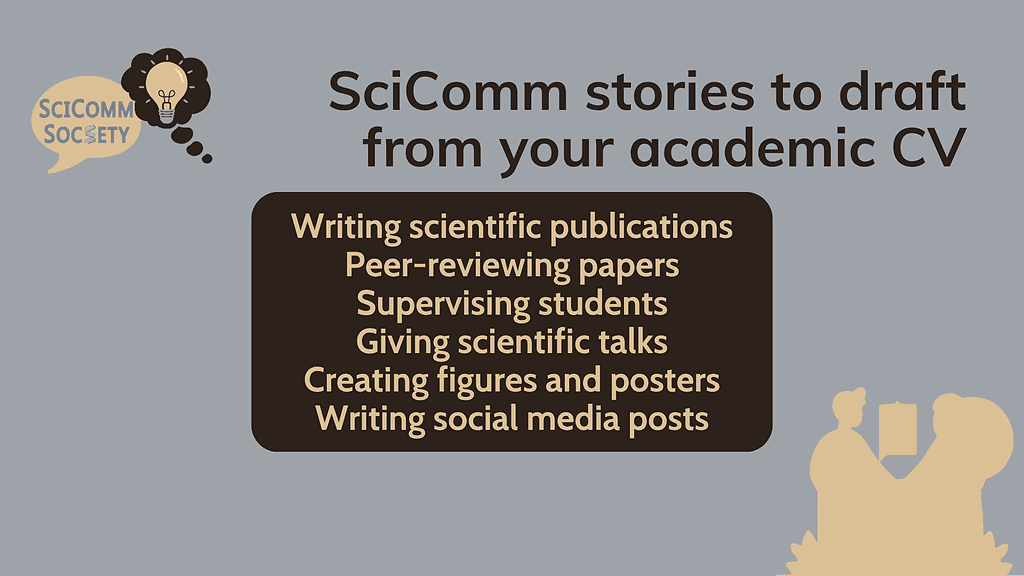
- Writing literature reviews and scientific papers
When researching a topic in depth and writing a scientific publication about it, you demonstrate synthesis and sense-making skills. You asked questions and closed knowledge gaps, restructured scientific concepts and created new models based on scientific evidence. This transformative research journey is worth highlighting in every SciComm portfolio.
- Peer-reviewing papers
To edit other researcher’s publication, you need to open your mind to a topic which may be distantly related to yours. You took in new information and critically evaluated experimental results. It requires curiosity and systemic thinking to analyse results from others and edit someone else’s written piece to create a comprehensive scientific narrative.
- Supervising students
When your mentor trusted you with the task of supervising and teaching others, they already acknowledged your science communication skills. It shows that you can adapt your communication to different audiences, making your project engaging and comprehensible even to beginners in the field.
- Giving scientific talks
Nothing needs more narrative structure than scientific presentations and talks. Creating a compelling talk from your research project shows that you see the big picture, adapt content to your target audience and can find suitable analogies and narratives to convince them of your science.
- Creating figures and posters
Producing visual content is yet another crucial science communication skill. You are not only able to write and talk about science, but also to arrange data visually so they tell a story, engage and make sense.
- Writing social media posts
Maybe you’ve been talking about your research on social media. And if so, you’ve created some essential science communication skills! You showed that you can break down scientific content into small pieces of information and adapt them to different audiences. Maybe you even created visuals for social media, which will boost your SciComm portfolio even further!
How to write your SciComm portfolio?
I hope you can see here that, as a scientific researcher, you are already developing a portfolio for a potential science communication career. It is just a matter of transforming your academic CV into a narrative structure to highlight your communication skills.
Check out the FREE Notion template to start your SciComm portfolio!
As you wrote scientific publications, grant applications or social media posts for different audiences, you showed that you can adapt your narrative, message and format. Consistent publications, for example on social media, highlight your commitment, prove that you can repeat the process and have a system in place. These are valuable project management skills every science communicator should have!
Are you interested in developing more engaging content for your SciComm portfolio? Then check out the 50-Day SciComm Sprint. This FREE Notion template provides you with one prompt per day. After 50 days, you will have created several science communication drafts and publications about your research, together with visuals and promotional material for social media.
Get the FREE 50-Day Research-to-SciComm Sprint Notion Template.
Now it is up to you to keep working on your SciComm portfolio and showcase your skills. Which stories about your academic journey will you tell based on your research and your core values? I am looking forward to reading them. Share on social media and add #MySCSImpact, so I can share them too!